 The molecules in a crystal are in a regular arrangement, in which ideally they are all in identical positions, like soldiers in a perfectly ordered parade. And crystals have many useful properties, they are the best conductors of electricity. But crystals are rarely perfect, and these imperfect crystals may have higher resistance to electricity.
Author Archives: Richard Sear
Computational physicist at the University of Surrey. My research interests are in COVID-19 transmission, especially masks, soft matter & biological physics
Does a restaurant count as research impact?
I am currently pondering this question. UK Universities are assessed by the UK government in many ways. One of which is via the “impact” of our research, defined as being “An effect on, change or benefit to the economy, society, culture, public policy or services, health, the environment or quality of life, beyond academia.”. At the University of Manchester, Andre Geim and Constantin Novosolev won the 2010 Nobel Prize in Physics, for their pioneering research on graphene – a hi-tech material made of incredibly thin chicken-wire-like arrangements of carbon atoms.
Mistakes made in mending a broken heart
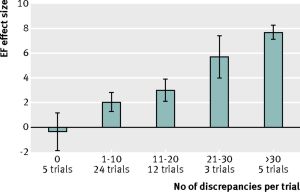 I have just come across a striking but slightly scary paper. The paper looked at errors in scientific papers reporting on the use of stem cells to treat heart problems. Our heart is a muscular pump, and its muscle tissue has very little regenerative capacity*, so a heart attack can damage it permanently. The idea here is that by transplanting stem cells into a damaged heart, the stem cells can partially regenerate damaged muscle tissue, and so reverse damage due to the heart attack. The repair can be measured by what is called the ejection fraction (EF), which measures basically the fraction of the blood inside a heart chamber that is pumped out in one heart beat.
When average is not enough: part II
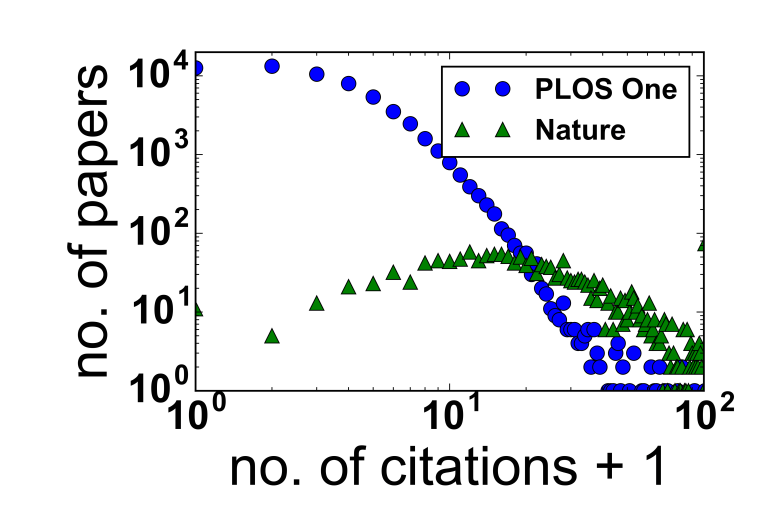
 An earlier post showed the data (blue and green symbols) above but not the fits (cyan and re curves). The data are for the number of papers published in two scientific journals, Nature and PLOS One, as a function of the number of citations (+1 so it fits on a log-log scale plot), that the paper received. So for example, the blue circle at the top left edge is at x and y coordinates of 100 = 1 and 13,000, meaning that PLOS One published 13,000 articles that were cited 1-1 = 0 times. The papers were published in 2013 and 2014, and the citations were in 2015. The mean number of citations is the Journal Impact Factor (JIF), so the JIFs of the two journals are the means of the distributions above.
When average is not enough
 The modern way to measure the performance of universities, departments and academics, is via metrics, i.e., numbers, as opposed to qualitative opinions of peers in the field. All sorts of numbers are available nowadays, and these numbers are much much faster to work with than getting an expert opinion. They can be used by managers who don’t have the expertise to assess the quality of research, and by academics who don’t have the time. And you need numbers to compile league tables, which are very popular.
There will be more rejoicing in the academic common room over one initially immature student who matures than over ninety-nine students who do not need to
 A couple of weeks ago I was in on an University open day, talking to (approximately 17-years old) prospective students and their parents, today I was at our graduation reception, talking to the (21 to 22-year old) graduating students and their parents. The parents don’t change much between these events, the kids change a lot. It is just great to chat to our happy graduates and their proud parents. The parents are so proud of their kids. These graduates have worked hard and it is pleasing to see them being rewarded. It is a great feeling to know that you helped them.
Gareth Bale is our Dragon-King
 I am writing this after a day at a statistical physics conference in London, and before kick-off of the Portugal-Wales Euro 2016 semi-final. My team (Wales) are one match from their first ever final of a major championship, so I am partly writing this as a distraction from getting stressed. The pre-match build up heavily features Wales’ star Gareth Bale.
Dragon-King sounds like the title of a kids’ movie, but in fact it is the impressive sounding name a statistical physicist called Didier Sornette has given to a type of extreme (large) event, such as a stock market crash, a big earthquake, a massive meteorite strike, a once-in-a-century heatwave, etc. The idea is that if you want to model say stock market movements, then you may need one model for the run-of-the-mill market fluctuations but a different model for the once-in-fifty-years crash. This crash is your dragon-king, king because it is so big, dragon because it has a different, more mysterious origin, than the usual events.
Every one is different, no one is perfect, this is a big problem
 Famously, each snow flake is unique, no two are the same. This is really true. As the crystal lattice of ice has six-fold symmetry, so do snow flakes, which are ice crystals. But this symmetry is never perfect. If you rotate the crystal above by 60 degrees then it would look different, just not as different as if you rotated it by say 45 degrees. If you rotate it by 60 degrees, then you rotate each arm into the position of the next arm and as the arms are roughly similar the crystal will not look very different, bit it will look different.
Far from crystal clear
A PhD student working with a colleague and I has some great data on crystallisation of a molecule that can crystallise into not one but two different types of crystals (usually called crystal polymorphs). The molecule is a small amino acid called glycine, and the two different crystals we see are the alpha and gamma polymorphs. The motivation is kind of to see how you would get one polymorph or the other, and to understand what is going on. Following earlier workers we have found that if we add salt to the solution we get more gamma and less alpha. So that is relatively straightforward.
Quantum computers explained so simply even I can understand
Although I am physicist, I don’t have much to do with quantum mechanics. I teach elementary bits of it here and there, which is fun, but I do research on classical systems, so I don’t have a particularly good grasp of quantum stuff. So although I occasionally see some of the hype, and controversy, over quantum computers, I have not really understood what they actually are. But recently, I came across the blog of Scott Aaronson, a scientist in the field who, I think, explains it really well.

