The problem of a long filamentous virus like Ebola surviving, or not surviving, the violent process of becoming airborne, is complex. I always think it is best to start simple, so we need to simplify the problem.
Author Archives: Richard Sear
Computational physicist at the University of Surrey. My research interests are in COVID-19 transmission, especially masks, soft matter & biological physics
Simulating polymers being pulled apart
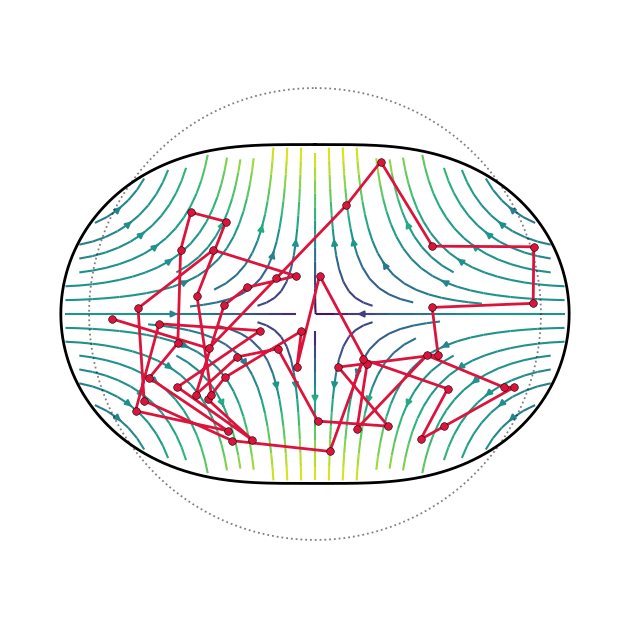
It is well known that very long DNA is vulnerable to being pulled apart. For example Joneja and Huang showed that initially much longer DNA fragmented into lengths of a few kilobases (about a micrometre) long, when the solution was repeatedly pushed through 0.5 micrometre pores. The flowing solution has to channel in to the pores and then spreads out on the other side of the pores, and in both cases this creates shear in the solution. It is easy to simulate a simple model of this, which is what the video shows.
Stretching and shearing beneath a small wave
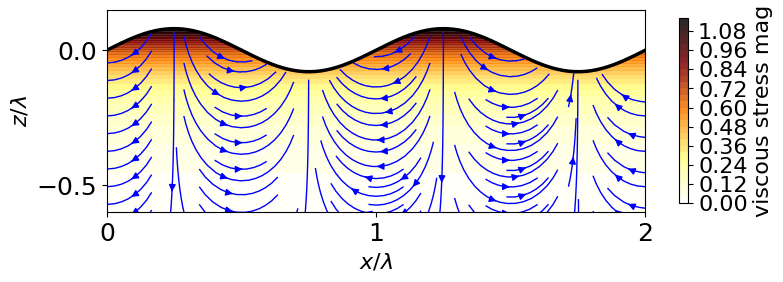
As aerosol droplets form, there are fast flows of liquid as it rearranges itself into the spherical droplet. These fluid flows generate viscous stresses (forces), in fact these forces are the ones that slow down the flow to form a finally at rest liquid droplet. The viscous forces are quite complex, they vary in relatively complicated ways in both space and time. And viscous stress is a relatively complex beast, it is a tensor not a scalar or a vector, so in 3D this is 6 numbers*. So perhaps it is best to start with a simpler system than a forming droplet. Maybe the simplest system is a liquid whose surface is moving due to being perturbed by a simple sine wave. A surface perturbed by a sine wave along the x axis is shown above**, with the streamlines of the resulting liquid flows shown in blue.
Stretching DNA and filamentous viruses with shear
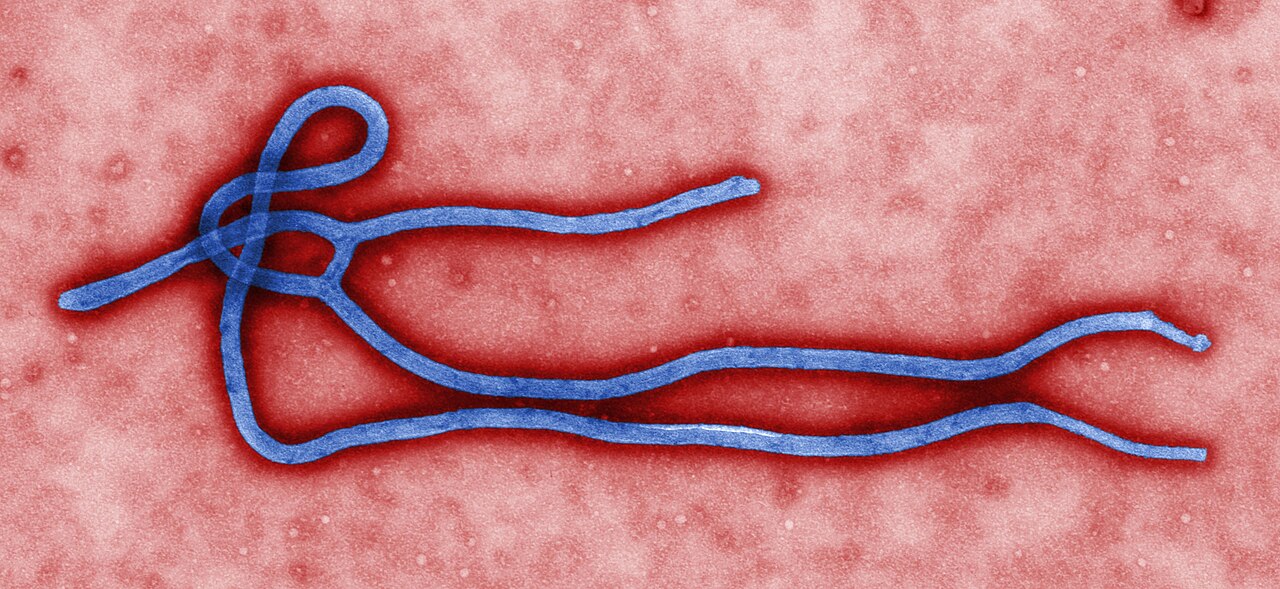
It may be that the deadly Ebola virus* is only very inefficiently transmitted across the air, in aerosols. If so, then I am not sure anybody knows why. But we can speculate. The formation of aerosols involves very short lived (much much less than a second), but very fast (metres per second) flows, as the aerosol droplet’s surface tension pulls the newly formed droplet into a sphere. These shearing forces can potentially damage viral particles, destroying them just as they become airborne in an aerosol droplet, and preventing their transmission across the air. These shearing forces may (or may not?) be much more dangerous to long filamentous viruses such as Ebola, than compact spherical viruses such as SARS or flu. Ebola – see image above – has viral particles that are over 10 micrometres long and filamentous. SARS and flu viral particles are roughly spherical and around 0.1 micrometres in diameter.
log-normal distributions in COVID transmission

log-normal distributions of variables, eg viral loads, are related to power-law distributions, and the two functions are often used in similar situations. Both power laws and log-normals are distributions for a variable, for example an amount of virus. A log-normal distribution is such that the distribution of the log of the variable is the normal, or Gaussian distribution. The Central Limit Theorem of statistics tells us that generically a normal or Gaussian distribution arises for any property that is the sum of many smaller steps each of which has a randomly varying part. The same theorem implies that a log-normal distribution arises for any property that is the product of many smaller steps, each of which has a random part.
Power laws in COVID transmission
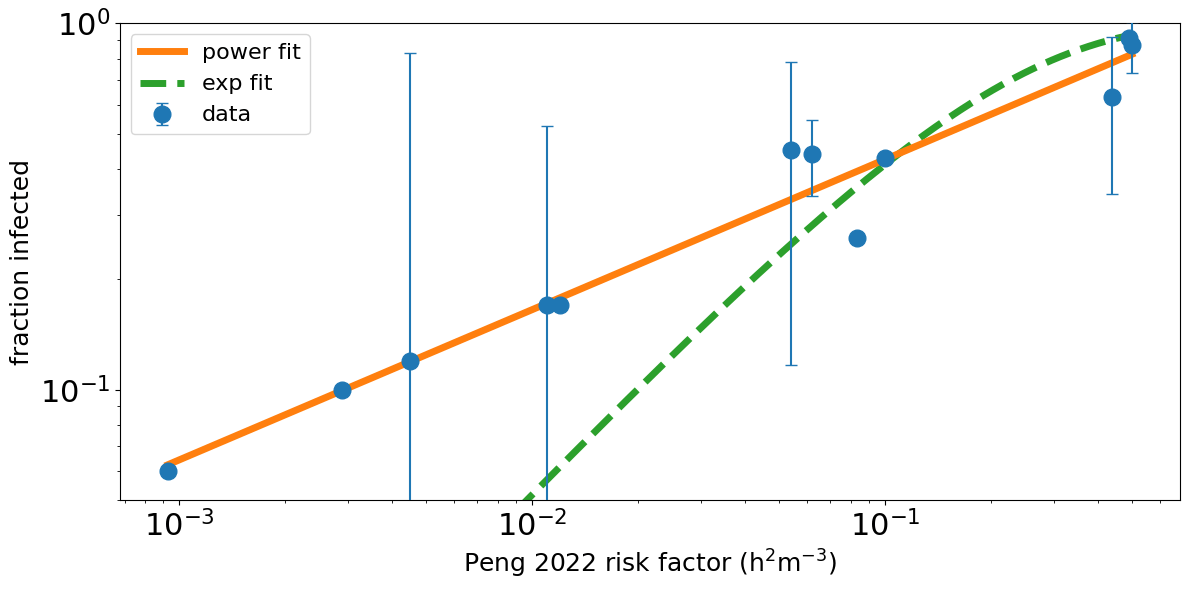
Peng and cowokers gathered together data on 12 (possibly not very representative) events where COVID was transmitted. For each event they estimated a relative infection risk factor Hr*. They then plotted the fraction of people infected (an estimate of the probability of infection), as a function of this estimated relative risk factor. They compared with the standard model for disease transmission – the Wells-Riley model (which is really just Poisson statistics). A fit of this model to their data is shown as the green dashed curve in the plot above. It is not a great fit**.
Fewer children sick with flu: Cheap at £15 per child per year
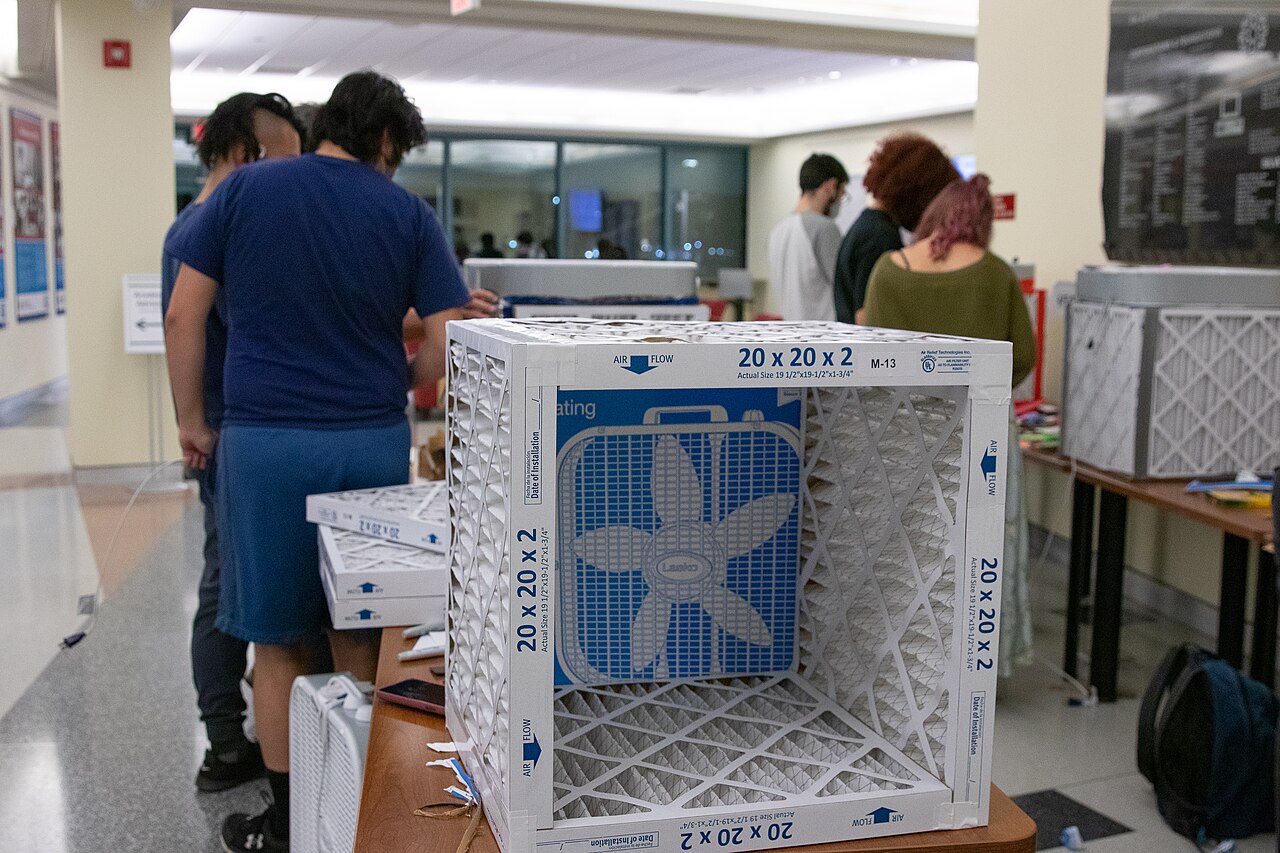
A standard air filtration system* costs very roughly £450 per year, so one in a classroom with 30 children costs £15 per child per year. The unit filters air such that it filters the classroom air around twice an hour. If we start with a perhaps typical classroom where the ventilation turns over the air twice an hour, then the filter doubles the air turnover rate and so should roughly halve the amount of aerosolised virus in the air. Using the formula in my previous blog post, this gives an estimated 20% reduction** in transmission of flu, COVID and other airborne diseases. For £15 per child per year.
Is a 40% reduction in flu transmission enough?
The Intercept fund starts with some strong statements:
Respiratory viruses kill 1 million people a year, cost us $600B annually, disrupt everyday life, and periodically threaten civilization.
and has some ambitious goals to improve the quality of the air we breathe in while indoors, the indoor air quality (IAQ):
Our goal is to catalyze the uptake of air cleaning technologies that safely reduce infectious aerosols by >75% and have a path to >50% uptake in transmission-relevant indoor spaces at low cost.
This level of ambition is, I guess, to be expected from a charity funded by the charitable arms of Anthropic and OpenAI, currently building trillion-dollar data centres*.
How Viruses Survive in Aerosol Droplets
Viruses like flu and SARS-CoV-2 (the cause of COVID) spread across the air in aerosol particles, often of order a micrometre across. To do this the virus needs to survive intact the rather violent process whereby a tiny droplet breaks off from a liquid. In this case the liquid mucus lining our throat and lungs. Violent here includes some rather fast, metres per second, flows as the droplet breaks off from the liquid and rounds up into a sphere. I estimated the shear stresses involved in this process in an earlier blog post as
where η is the viscosity (saliva is only a bit more viscous than water, at around 1 mPa s), Γ is the surface tension (about 0.05 N/m), ρ is the mass density (1000 kg/m3) and dD is the droplet diameter.
(Some) LLMs (with some help) can now do a toy simulation of a droplet in shear
One area where LLMs like OpenAI’s ChatGPT, Anthropic’s Claude etc are already making a splash, is coding. But scientific coding is tricky, even small errors can result in the code crashing or producing nonsense. Last year, a student working with me found that even for a relatively simple code, the results were often very wrong. But that was last year.

