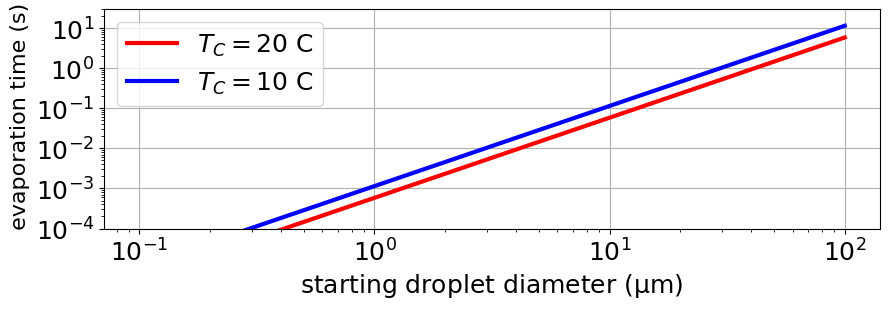
The evaporation of water droplets is a lot more complex than you’d think or hope. One reason is that small water droplets, at least in not very humid air, evaporate so fast that the evaporation cools them. This is just like when you blow on hot coffee to cool it, you increase the evaporation rate and this cools the coffee. Evaporation takes energy, called latent heat levap, which for water is large. At room temperature the latent heat is a bit less than 10−19 J per water molecule that evaporates. Calculations by Hardy et al. find that it can cool an evaporating water droplet by more than 10 C.
In 1918 Irving Langmuir derived an expression for the diameter d of an evaporating sphere of iodine as a function of time t. He assumed that the rate limiting process is diffusion of the evaporated water molecules away from the surface of the droplet, to far away from the droplet*. He neglected evaporative cooling – which may be a much better approximation for iodine than for water – and obtained the expression
where d0 is the droplet diameter at the start of evaporation, at t = 0, and the constant K is given by
where the diffusion constant of water molecules in air Dwair ~ 10-5 m2/s,
At the surface of the droplet the water vapour is in local equilibrium with the very close water droplet, at the equilibrium saturation number density nv,sat, while far from the droplet the water molecule number density is that in the bulk of the air: n∞. When the humidity, as measured by Relative Humidity (RH), is less than 100%, then nv,sat is larger than n∞ and so there is a diffusive flux taking evaporating water away from the droplet.
The evaporation constant K depends on how many molecules we need to evaporate and so on the number density of water molecules in liquid water: nL ~ 1028 /m3. At 20 C the ratio nv,sat/nL ~ 10-5 and so K ~ 8 × 10-5 × 10-5~ 10-9m2/s, at 20 C, at low RH.
The evaporation time is the time for d to reach zero, d(tevap) = 0 and so
The time for a droplet to evaporate increases as the square of its initial diameter. This is shown in the plot above. This is due to a balance between the number of molecules that need to be evaporated away increasing as the cube of the diameter, while the diffusive flux only increases linearly with the diameter. Note that droplets tens of micrometres across evaporate in around a second while smaller droplets evaporate much more quickly.
But this neglects evaporative cooling, the cooling of the droplet by the latent heat of the evaporating water molecules. If we look at the above equation for K we see that it depends on both Dwair and nv,sat. Now the diffusion constant is not very sensitive to temperature. But the saturation number density is very sensitive, it varies roughly exponentially with temperature, and so cooling can dramatically slow evaporation.
We can estimate the cooling by equating the
which is just the number of water molecules time latent heat per molecule, with the
which is the thermal energy flux per unit area κΔT/d0 times the surface area of the droplet d02 times the evaporation time. κ is the thermal conductivity of air.
The thermal conductivity (units of W/(mK)) κ = αcp where α is the diffusion constant for thermal energy in air and cp is the heat capacity of air per unit volume. As air is close to an ideal gas cp ~ kBnair, with kB Boltzmann’s constant. In gases all the diffusion constants for small molecules and for heat are around the same, so α ~ Dwair and we can write the thermal conductivity of air κ ~ Dwair kBnair.
We now need to equate the two expressions above. Then rearranging we have an evaporative cooling of magnitude
The number density of water molecules in air saturated with water vapour is about 1 % of the total number density in air (of all molecules not just water), i.e., nv,sat/nair ~ 10-2 and as levap/ kB ~ 104 K, this gives cooling of the evaporating droplet of around 10 C (or 10 K).
This means a droplet evaporating in 20 C air is closer to 10 C. This reduces the saturated vapour pressure of water in contact with the colder droplet, it roughly halves nv,sat which in turn roughly doubles the evaporation time. This is shown in the plot above**. For example, for a droplet that starts of with a diameter of 30 micrometres in air at 20 C, the evaporation time roughly doubles from half a second to a second, due to the cooling. And as the transport of water molecules and heat is both by diffusion the cooling does not (simply speaking) vary with the droplet size.
* This assumption that molecules just diffuse far away from evaporating droplet works in still air but if the droplet is moving sufficiently fast relative to the surrounding air, then this passing breeze accelerates evaporation. It is measured by what is called the Sherwood number but Judging from Su et al in 2018 the airflow correction may be small but I have not looked into the details.
** Plot is produced by this Colab notebook.


1 Comment