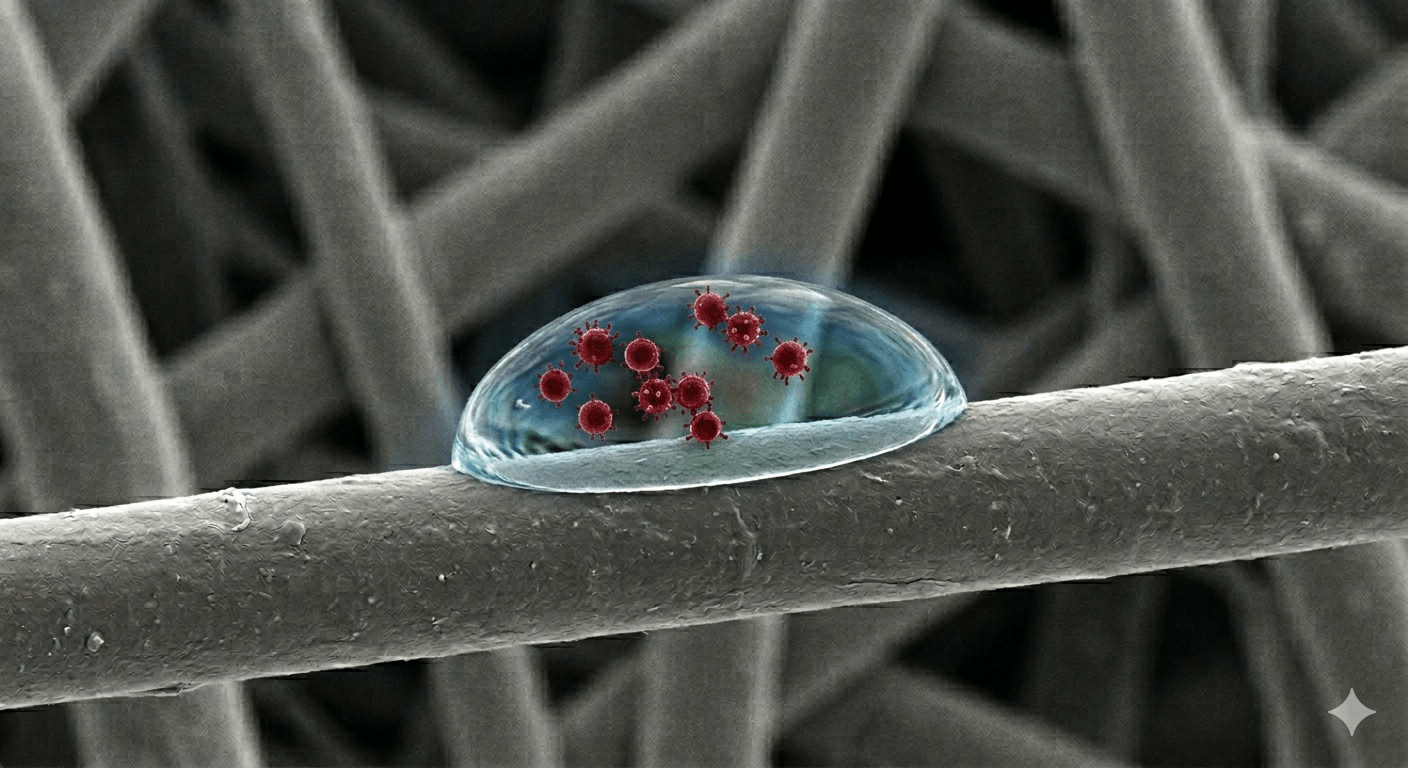
Masks exist to filter out harmful viruses and bacteria from the air the wearer is breathing. This protects the wearer, and if the mask wearer is infected, it protects others in the same room. Masks are air filters worn on the face and air filters are typically meshes of tiny fibres – illustrated in the rather shonky AI image above. They work by the virus-containing droplets in the air sticking to the fibres inside the filter, and so not going through the mask.
But then what happens to the virus-containing droplets stuck to fibres inside the filter material? There is understandable concern that the mask could be contaminated by these droplets, and that perhaps later infectious virus could be dislodged from the mask and go on to infect someone.
But to do this the virus may need survive minutes or hours inside the filter material of the mask. Can the virus do this? I am not sure anybody knows the answer to this question. As far as I know we have no data.
It is possible that the inside of a worn mask is a very tough place for a virus to be. For reasons I want to look at.
Studies of viruses like SARS-CoV-2 (that causes COVID) typically find that drying out the aerosol particle a virus is in, kills tens of per cent of the virus. For example, for SARS-CoV-2, Oswin and coworkers find:
A decrease in infectivity (in this work, defined as the proportion of virus remaining able to induce cytopathic effect) at low RH occurs almost immediately, falling to an average of 54% within 5 s ….
In fact I think that strictly speaking what the scientists like Oswin and coworkers find is that drying an aerosol particle out then rehydrating it in the liquid surrounding a cell results in a lot less infectious virus than just directly firing the aerosol particle at the liquid surrounding a cell. Any dried out aerosol particle needs to become liquid again in order for the virus to infect a cell, as these viruses infect our cells which are constantly immersed in liquid.
In a mask that someone is wearing, the wearer constantly breathes in the air of the room they are in – typically at a relative humidity (RH) of anywhere between 30 to 60% – then a few seconds later breathes out the air which comes from the lungs and is at an RH of near 100%. So the mask almost constantly has air coming through it, but the humidity (and temperature*) of this air is constantly cycling, as the wearer breathes in relatively cool and dry room air and breathes out their warm humid breath.
We breathe in and out every few seconds, so the humidity in the air coming through a mask cycles every few seconds. The aerosol droplets masks filter out are small, almost all are less than 100 micrometres across and often much smaller. Such small droplets can lose and gain water very rapidly. So how much water will a small droplet stuck to a fibre gain and lose during each breathing cycle?
The droplets that can contain virus are of saliva which is water plus a complex mixture of salts and proteins. I simplify things by ignoring the proteins and just considering a droplet of salt solution, that has about the same salt concentration as in saline drips – which gives around the same osmotic pressure as in our bodies. Then the question is: What happens to a droplet of saline solution, of say diameter 10 micrometres, that is stuck to a fibre in a mask and so experiences air of cycling RH?
The results of toy model calculations for how the size of a droplet varies when exposed to air of varying RH are**:
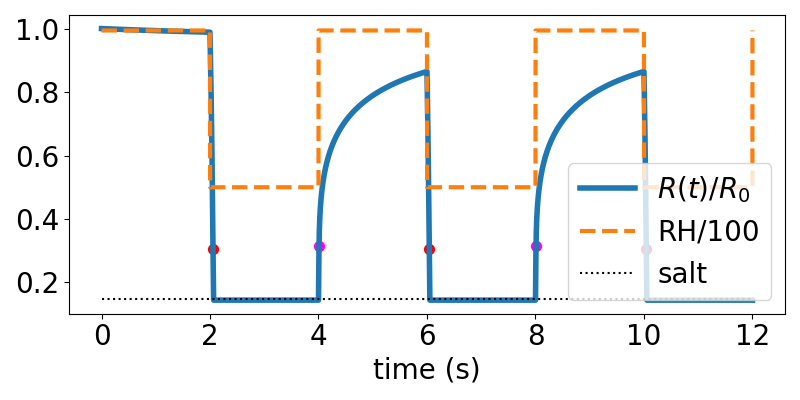
This is for a droplet that is initially 10 micrometres in diameter***. The x axis is time in seconds, and breathing in and out every 4 s is modelled as 2 seconds of 99% RH air followed by 2 s of 50% RH room air, followed by 2 s of 99% RH air, and so on. The orange dashed curve is %RH/100 so the result is a fraction. The blue curve is the ratio droplet radius at that time, divided by the initial radius, so it is also a fraction. This is so I can plot RH and droplet size on the same plot.
When at 2 s the RH of the surrounding air drops to 50%, the droplets lose water very rapidly. In much less than 2 s, it evaporates leaving no water just salt. The red circle marks the time and radius when salt starts to crystallise out of the drying droplet****, and the dotted black line gives the size of the salt crystal that forms when all the water has evaporated and we just have salt crystals left.
So at a the common RH of 50%, all the water evaporates, leaving salt crystals. But 2 s later the RH returns to 99%, and then the small salt crystal rapidly dissolves in condensing water. All the salt dissolves – at the point marked by magenta circle – and then the growing droplet of salt solution continues to pull in water molecules becoming larger and more dilute, until after 2 s at 99% RH it has grown to over 80% of its original diameter.
Then the RH in the surrounding air drops back down to 50%, and the cycle begins again. This occurs around a 1000 times an hour.
So any tiny salt-solution-droplet/crystal stuck to a filtering fibre in a mask is constantly evaporating then dissolving, then evaporating again, …., as the wearer breathes in and out. To me this looks like quite a hostile environment for a virus to survive in, but this is purely guesswork on my part. So I don’t know if, for example, hospitals are right to worry about worn masks containing dangerous infectious virus. Or whether almost all the virus has been destroyed by the continuous humidity cycling.
* Here I ignore the effect of temperature variations. This could be quite a bad approximation, I will need to come back to it.
** Plot produced by this Google Colab notebook.
***See previous blog post for the size dependence of droplet evaporation times.
**** The above plot ignores any barriers to salt crystal formation or dissolution, i.e., assumes that as soon as the droplet has evaporated enough to make it supersaturated with respect to crystallisation, crystals instantly form. This is not how crystals form, it is a lot more complex than that.


