Over the Christmas period I have been trying out a few beers, including Brewdog’s weirdly named Self Assembly Pope. This beer is a porter, with some cocoa, coconut and vanilla added to spice it up. It is a pretty good porter, although I am not a big fan of coconut, on its own or in beer, and so probably will not be coming back to it*. What I will be doing in 2017 is working on getting membrane proteins to self-assemble into as large and as regular crystals as possible. This is part of an EU-wide network on membrane-protein crystallisation that will be starting in 2017. Membrane proteins are proteins that live in back-to-back layers of soapy molecules — which is what cell membranes are. Membrane proteins are important as many (by some measures a majority) of drugs target these proteins.
Author Archives: Richard Sear
Computational physicist at the University of Surrey. My research interests are in COVID-19 transmission, especially masks, soft matter & biological physics
An early Christmas present
_2.png) Right at the beginning of this year, I was on a bid for EU funding, to develop new approaches in crystallising membrane proteins (an example membrane protein is shown to the left). The proposal was submitted in January. At the start of May we found out were on the ‘reserve list’, whereupon we assumed that that was it, we were unsuccessful. We exchanged gallows-humours jokes about feeling like an Olympic athlete who finishes fourth, and just misses out on a medal. A bit later we found out that the success rate was about 6%, apparently we were part of the 94% who failed. Six months has now passed since we learnt this, and we heard nothing from Brussels.
Right at the beginning of this year, I was on a bid for EU funding, to develop new approaches in crystallising membrane proteins (an example membrane protein is shown to the left). The proposal was submitted in January. At the start of May we found out were on the ‘reserve list’, whereupon we assumed that that was it, we were unsuccessful. We exchanged gallows-humours jokes about feeling like an Olympic athlete who finishes fourth, and just misses out on a medal. A bit later we found out that the success rate was about 6%, apparently we were part of the 94% who failed. Six months has now passed since we learnt this, and we heard nothing from Brussels.
The milk-fueled conquest of Europe
 I had milk on my breakfast cereal this morning, and I am writing a new lecture on evolution for my biological physics course. The connection between these two facts is the lactase enzyme. Baby mammals of all mammal species drink their mothers’ milk, which contains a lot of its calories in the form of the sugar lactose. The baby mammals produce the lactase enzyme in their guts to digest the lactose. But when they grow up they no longer drink milk, and as lactose is rare except in milk, the growing mammals stop producing the lactase enzyme.
Earthquakes as the price of cheap oil
 The graph above shows the numbers of earthquakes in the US state of Oklahoma, for each year from 1978 to 2016 (2016 data is only up September). The number is for earthquakes with magnitude greater than 3.0. There is a striking increase from 2008, when there were 2 earthquakes, to 2015, when there 890.
Students not impressed by Nobel-worthy teaching
Yesterday Sir Fraser Stoddart won a one third share of the 2016 Chemistry Nobel Prize, for developing molecular machines, i.e., molecules that act like machines in the sense that they can move, exert forces etc. Stoddart was an academic in the Department of Chemistry at the University of Sheffield, when I started as an undergraduate. He never taught me as I didn’t take his course, but he did teach friends of mine. They were not impressed by the future Nobel Laureate.
Crystals both large and small
 Above are crystals in a cave in the Mexican state of Chihuahua. They are huge, note that the person in the picture shows the scale. The crystals are up to 10 m long, have masses of tens of tons, and are made of gypsum, a form of calcium sulphate. It is estimated that they took hundreds of thousands of years to grow. So around about the time our ancestors were wandering around Africa, a tiny nucleus formed, and started to grow. Hundreds of thousands of years later, we have these enormous crystals.
Evolution in action
Seeing is believing, so it is good to see evolution in action. The above movie shows a huge petri dish with bacteria starting at both edges where there is no antibiotic. The dish has a gradient of increasing concentration of this antibiotic towards the centre of the plate. Initially they can’t grow in the regions where the antibiotic concentration is high. But they evolve resistance and just march up the gradient of the antibiotic. This takes about two weeks. Impressive.
Mathematics vs Physics degrees & Theoretical vs Computational Physics
I was on the Physics stand for Saturday’s university open day for prospective students and their parents. I got a lot of questions from prospective students who were still deciding whether to do a maths degree, a physics degree, or maths & physics. They were doing maths and physics A levels, but unless they go for a maths & physics joint honours, they will have choose one or the other at university.
Data science gone bad
I am reading, and enjoying, Weapons of Math Destruction by Cathy O’Neil. It is on the problems created for society by the use of algorithms and data. Data analysis is key to science and engineering, and so lies behind new medicines, faster computers etc, but like most powerful tools it is not guaranteed to always lead to good. It can create problems or make existing problems worse if used incompetently and/or in a way that benefits a few while hurting many.
How big is a crystal?
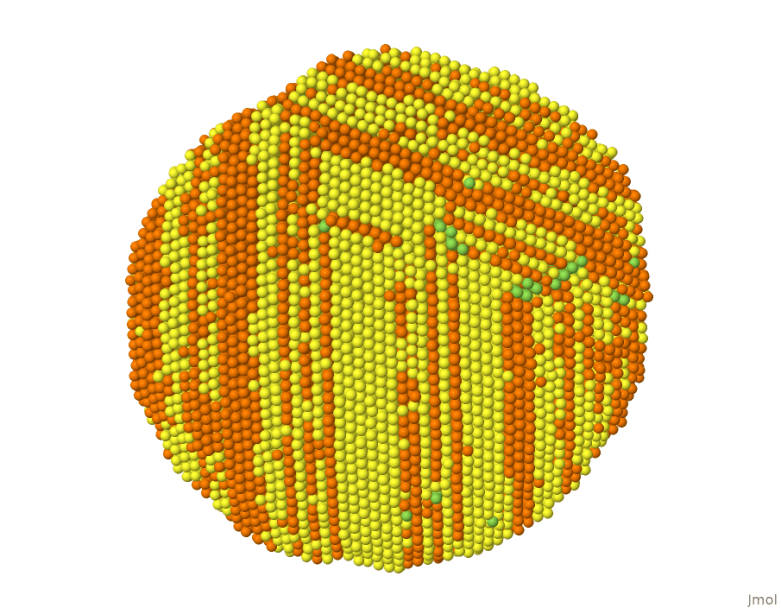 A basic question we can ask about any crystal is: How big is it? Many properties depend on size, so this is often a key question. Often it is not as easy to answer as you might hope. Take a look at the crystalline nanocrystal above. Its total size is about 59,000 atoms, or about 40 atoms across. But it is actually made up of two crystalline domains. To see this, look at the rows of yellow and orange coloured atoms, in most of the particle they are roughly vertical, but at the top right they are tilted a bit below the horizontal. So this is two crystals not one.

