Silicon Valley, the part of California just south of San Francisco may be home to the largest concentration of hi-tech firms on the planet: Apple, Google, Intel, …. We take this for granted, as this has been true for a while. But I am reading Broken Genius, a biography of Bill Shockley. Perhaps more than anyone, Shockley is responsible for Silicon Valley being in California.
Lobster every two years, always on a Thursday
 The week before last I was at a conference on crystallisation, held in Maine, USA. It was run by Gordon Research Conferences, who run many conferences in the summer in New England (far north-east of the USA). The local specialty is lobster, which is caught off the coast of Maine, so lobster is on the menu for the conference dinner on the last day of the conference. The conference runs every other year, so every other year I have lobster. Always on a Thursday (last day of the conference). Thanks to this conference, my lobster eating is very regular.
A life in the day of an academic scientist
Friday 3rd July started with breakfast in the cafeteria of the University of New England, in Maine, USA. I had a very interesting chat, over breakfast, with the previous night’s seminar speaker. We were at the University of New England for the Crystal Growth and Assembly scientific conference.
Physics is wonderful, its applications are sh*t, Engineering is sh*t, its applications are wonderful
I’ve spent the week in a sunny Dublin, at a workshop on crystallisation. The workshop looked especially at using computer simulations to understand the fundamentals of crystallisation, and on applications to crystallising drugs. Most drug tablets, like aspirin, paracetamol, etc, are crystals. So at the workshop there was a mixture of physicists, chemists and chemical engineers, and some of us were from universities and some from drug companies.
It was really interesting to hear about all the challenges involved in making a drug tablet that works, in the sense of delivering the drug to you in a safe form while dissolving in your stomach and/or intestines. I did not realise that some drugs are so insoluble in the water inside your intestines that not only is it hard to get them to dissolve there, but even once they are dissolved they can reform crystals inside you – which of course is very undesirable.
Boosting the economy by discouraging rent seeking
“Rent seeking” is an technical term used by economists. There is a good Wikipedia page, but roughly speaking it means investing money to make more money via ways that do not grow the economy, i.e., do not increase the sum total of a country’s wealth. The idea is basically that if someone invests money by say buying a house and renting it out, then they are making money for themselves without making the country wealthier. On a bigger scale, if say a utility such as electricity is supplied by a oligopoly with minimal competition, then the companies of the oligopoly can make a lot of money from their customers by charging high prices. But if anything this profit making harms instead of boosting the economy. Both these are examples of rent seeking; rent seeking in this sense can involve literal rents such as for houses, but it does not have to. In contrast if money is invested, say, to make a better, more fuel-efficient engine for airliners, then the company makes profits from selling the engines, but cheaper air travel could then boost the economy, making others richer too. This is the econmially good, non-rent-seeking way, to make money.
The economic cost of inequality
I am reading a economics book. A book on economies with huge inequalities of wealth, where the economy is not growing because the rich do not invest, they just squeeze the poor for increased rents, and where nothing is done to change this as change is not in the interest of the wealthy. As you imagine this is striking a chord with me, it all sounds very familiar.
Touching is believing
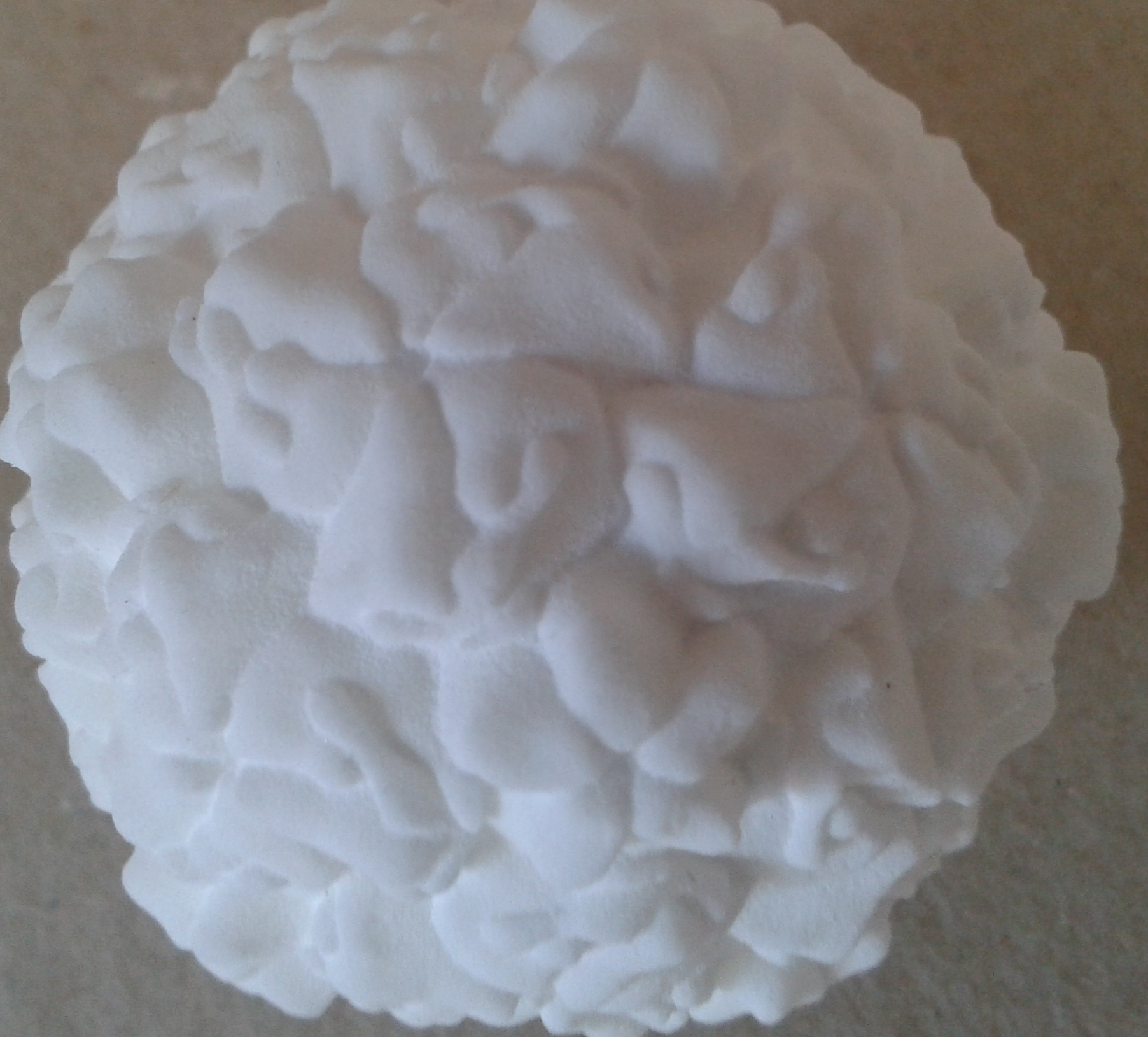 At a workshop I was at in Princeton in April, one of the speakers illustrated a rather beautiful state of matter called the gyroid phase, by passing round a 3D printed model of this state of matter. I was instantly both impressed and envious. There is a cool gif of the gyroid here, but holding a model in your hands and turning it over to see it from all angles, is better than any picture on a 2D screen.
Flaming ice
 I am doing a bit of reading up on a substance that looks like ice, but, as you can see, burns. The substance is called gas hydrate or methane hydrate. It is a crystal and it looks like ice because it is quite like ice. It is a crystalline arrangement of water molecules, like ice. But the arrangement is a bit different. The water molecules form an array of cages. A cage of water molecules is shown at the top left — H20 molecules are shown in red (oxygen atom) and white (hydrogen). In these cages sit methane molecules. A methane, CH4, molecule in the cage is also shown. It is the methane that allows these crystals to burn.
Different standards for graduate recruiters and universities
One of the largest, and maybe most prestigious, recruiters in the UK, PricewaterhouseCoopers (PwC) has decided to stop using A-level grades (via a UCAS points score) as an initial selection mechanism for applicants to its graduate scheme. See here for the story in The Guardian and here for a post on a PwC blog. Previously PwC required that any applicant have to have at least 340 UCAS points to be considered. As an ex-admissions tutor who used these same grades to select prospective students, this caught my eye.
India’s monsoon and Surrey’s green fields
I got back from a couple of workshops in Princeton in America yesterday. They included a talk by an author of this paper on how we appear to be changing the summer rainfall that India relies on to grow the crops to feed its billion people. On my doormat I found an election flyer by the Guildford’s save the greenbelt party. There is an election in the UK the week after next. They want to stop house building on green fields in the Guildford area. I don’t doubt their sincerity, and green fields are something we all enjoy. But when you read about the changes in rainfall that crops required by a billion people, this does look a bit parochial.
 Chance & Necessity
