 I am currently teaching biological physics to third-year physics undergraduates. As part of this I teach about how living organisms acquire food molecules, oxygen etc, and how large living organisms, such as ourselves, transport these food molecules, oxygen, etc around our bodies. A fundamental point that I make, is that diffusion is only fast enough to support the demands of life when the movement is over very small distances, around 1 mm or less. Over distances more than very roughly 1 mm, some sort of flow is required to move molecules around. Over distances of centimetres, metres and above, diffusion is very very slow.
Teaching data fitting better
One of the most useful skills we teach on the physics degree is data analysis. This is important in almost all scientific research, and it is also key to good decision making in other fields such as economics, as well as being a core part of data science — increasing numbers of our graduates are going into the growing number of careers as data scientists. One basic task in data analysis is fitting a model to noisy data, eg fitting a straight line y = mx + c to data of the form a set of points (x , y). As far as I know there is essentially complete consensus about how to determine the best values of the two fit parameters, the intercept c and the slope m. This is to minimise the sum of the squared differences between the fit function, and the data points.
From crisps to £800 skin cream
 I have just gotten back from the 3rd Sir Sam Edwards – New Horizons in Soft matter meeting. The meeting has an emphasis on bringing together soft matter scientists from universities and companies. As a university-based scientist it is fascinating to hear of the soft matter challenges companies face.
These vary from turning tons of potatoes into crisps, to making cosmetics that are sold for silly money.
Pac-man: The ultimate test of a human
I have just finished reading Outnumbered by David Sumpter. It is very readable, and says some interesting things about modern machine learning. Machine learning, in particular deep learning, is a hot topic at the moment, so I was curious to read about it, and about related stuff like how Facebook, Google, etc, use it.
Eating for ten trillion
Adults are recommended to eat about 2000 kilocalories per day. As this is an energy divided by a time it is a power consumption, and in the proper units, it is about 100 Watts. The power consumption of our bodies is a pretty basic feature of how our bodies work, but there is not much known about why a 80 kg guy like me needs 100 W, not 10 or 1000 W. We know* our brain needs of order 10 W, and our heart about 1 W, but for example we have only a poor idea of why our brain burns through 10 Joules every second.
A whole lot of gelatin
Over the summer I am thinking a bit about how proteins and other stuff move around inside our cells, and those of other living organisms. I am trying to do this quantitatively, and so I need numbers for various aspects of living cells and of organisms. So I was delighted to find that there is an entire searchable website just for numbers related to living organisms, called, sensibly enough, BioNumbers, plus a related book: Cell Biology by the Numbers, by Ron Milo and Rob Phillips. Both websites are a mine of useful information. For example, one entry is the total length of fibres of the protein collagen in our bodies. The total length is about 100 billion kilometres, or to put in another way, in each of our bodies there is enough collagen to go from the Earth to the Sun 10,000 times.
There is a lot physicists don’t know about living cells, but we do know some things, such as you don’t have hot mitochondria
 Last year, Chrétien et al. published a paper in PLOS Biology on mitochondria. Two mitochondria are shown above, they are structures inside our cells where a key part of our energy metabolism take place. I don’t want to be harsh, but the central claim of their work is clearly wrong. This claim is that the mitochondria inside cells are at a temperature of around 50 C, more than 10 C higher than the rest of the cell which is about 37 C. This really cannot be right, the mitochondria inside your body are at the same 37 C that the rest of you is, and with a little physics it is easy to see why.
Being useful to molecular biologists really boosts your citations
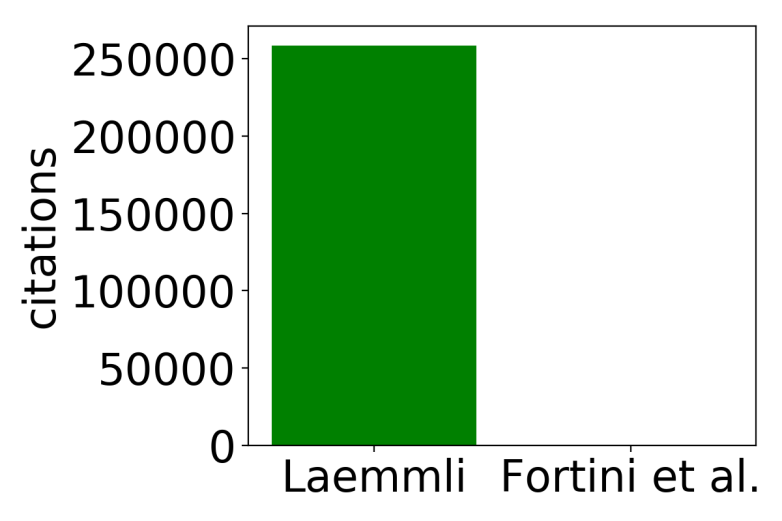 In an earlier blog post, I noted that by one metric for the impact of my published work I lose out to F.D.C. Willard, who was a cat. In a similar vein, above I have plotted the number of citations to my most highly cited paper of the last few years, Dynamic Stratification in Drying Films of Colloidal Mixtures by Fortini et al., together with the number of citations of a 1970 paper by Laemmli. In Laemmli’s paper, he pioneered a technique called SDS PAGE. Note that the column with our paper appears blank, this is because on the scale of the plot, the bar for our paper is less than one pixel high. At the bottom I have replotted this bar graph on a logscale, where you can see the number of citations of our work.
Dissolving in a hurry
We have all added salt or sugar to water and seen it dissolve. Both salt and sugar dissolve rapidly, but exactly how fast do they dissolve? This is one of those seemingly innocent questions, that is a lot harder to answer than you might expect, or hope. For something highly soluble like salt we expect the sodium and chloride ions at the surface of the dissolving salt crystal, to very rapidly move into solution in the surrounding water. But if the water is stationary, not stirred, then near the surface of the salt crystal, we quickly reach the point where the water is saturated with salt, and no more can dissolve, until the sodium and chloride ions move away.
Attendance predicts attainment, so we need to encourage attendance
There is a pretty big push at the University of Surrey to record lectures, so students can view them at another time. I think recording lectures is popular among many students, and I plan to do it for one of my courses next year. But another question is: Does it help students learn more? A recent study by Edwards and Clinton suggests that it does not.

