Particularly in the early stages of the COVID-19 pandemic, there were still medics who thought that because the virus was confined to some sort of mythical fast dropping, droplets, the virus could only be transmitted over distances of a metre or two. The virus could not go further. This can’t be true as it conflicts with basic aerosol physics. And there is pretty strong, pretty direct, evidence for transmission of COVID-19 across large rooms. But what I had not appreciated until this week was that people studying transmission of the virus that causes foot-and-mouth disease*, have pretty good evidence that the virus can carry over tens of kilometres. For example, from northern France across the English Channel to the Isle of Wight. The distance from the Isle of Wight to France is of course a lot more than two metres.
Author Archives: Richard Sear
Computational physicist at the University of Surrey. My research interests are in COVID-19 transmission, especially masks, soft matter & biological physics
Viruses need to survive a large but slow shock, to spread across a room

Someone infected with COVID-19, flu, measles, maybe mpox, or any one of a number of a bunch of viruses, breathes out the virus in tiny (micrometre) droplets of mucus. The droplets start in the infected person’s breath, which is saturated with water, i.e., at 100 % relative humidity (RH), because the breath has come straight from the infected person’s lungs. As the breath mixes with the air of a room (or of the surrounding air if they are outdoors), the humidity drops from 100% to the typical 40 to 60% of the air in and outdoors. This mixing takes a few seconds, and driven by this change of humidity the droplet dries out. The virus needs to survive this sudden drying intact, in order to go on to infect a new person. Drying in a few seconds may sound quick, but viruses are small so this may actually be felt as slow drying by the virus.
Masks when you are breathing: A hostile environment for viruses?
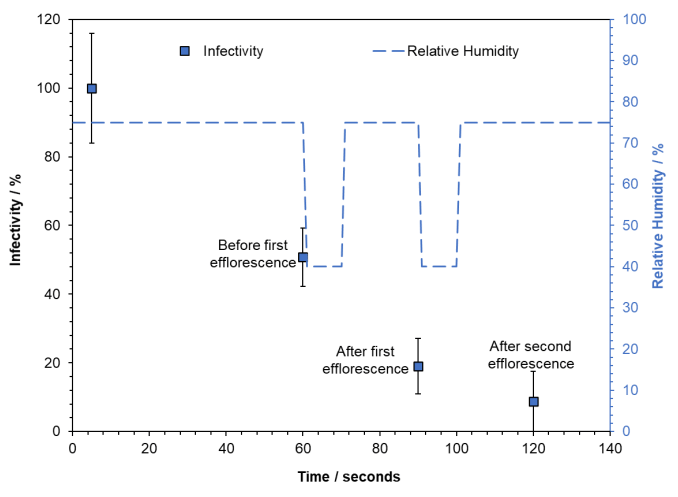
Early on in the pandemic there were all sorts of schemes going around to allow FFP2 and N95 masks to be reused; in hospitals they are traditionally worn only once (for say a single shift) and discarded but then there was a shortage so people wanted to extend the period a mask could be used. Were these schemes to try and clean a mask needed?
Tyndall showed us that dust is repelled by heat and attracted by cold
In 1870 John Tyndall was a prominent Irish scientist; he is now perhaps less known, possibly because he studied unglamorous things like dust. In a presentation that year he noted that a heated wire repelled dust particles. Note that this is separate from the convection of the air itself that the heated wire also causes. In addition to the convection the particles move relative to the air. Shortly afterwards his contemporary James Clerk Maxwell gave the following explanation, which is probably mostly right*.
COVID-19 infections come in three to four-month-long waves, for some unknown reason(s)
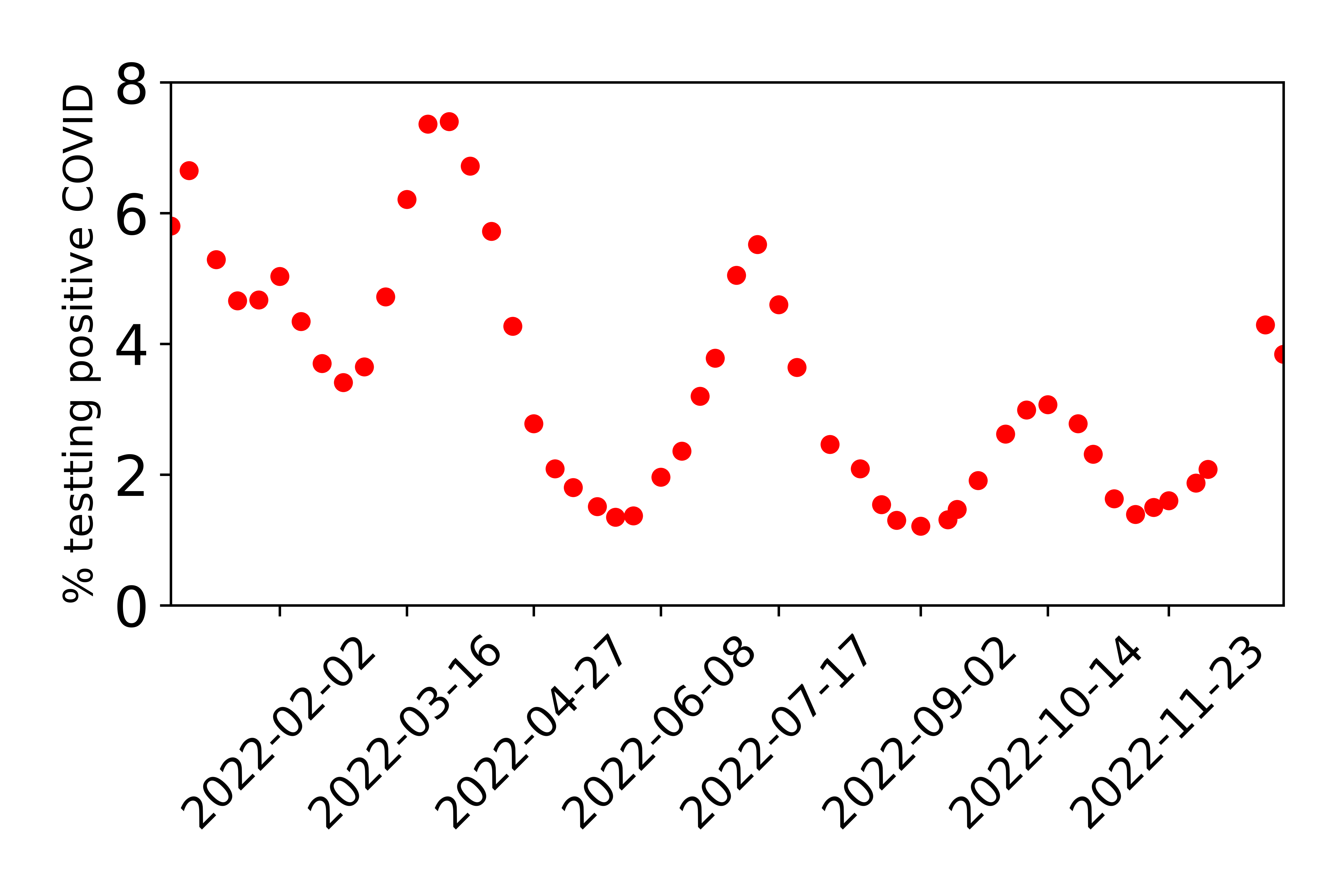
The title of this blog post kind of says it all, see the plot above. The plot is for the calendar year 2022 and for each week shows what percentage of COVID tests come back positive, saying that the person is infected. Data is from ONS. Note that 2022 starts with the back end of a wave. At the start of the 2022 infections were high but dropping, then there are peaks around March, July and October, before infections start climbing again at the end of the year. So the data are as clear as day, the question is: What is going on? Why the wave every three to four months?
With all windows shut, the air in my home turns over about once per ten hours
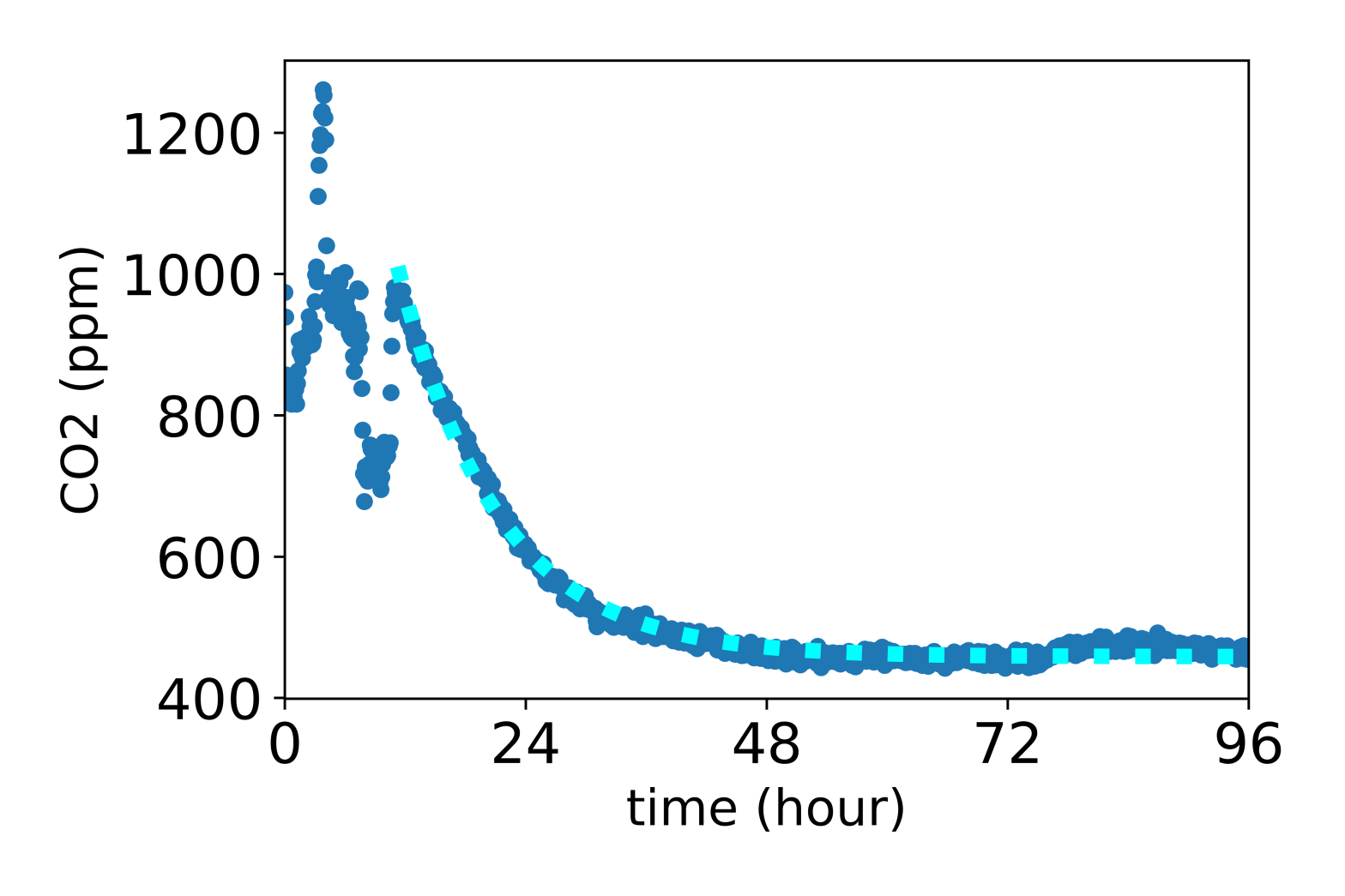
Over part of Christmas I was away for a few days. As you can see from the plot, this was long enough for the CO2 concentration inside my flat to relax to the atmospheric value (or close to that) of a bit over 400 ppm. The plot has time as the x-axis, starting at midnight of the day I left. I left at about midday of the first day and the CO2 concentration then relaxed back to about 450 ppm, and stayed there. The relaxation is well fit by an exponential function with a time constant of close to ten hours. The fit is the dashed cyan curve.
Better air quality at a cost of 1 p per hour per room
I typically leave a bedroom and a kitchen window open a crack, for ventilation. This time of year this lets in cold outside air that has to be heated to keep the flat warm. This costs money, but we can estimate that cost. See if it is large or small.
Keeping the air you breathe at home reasonably fresh in winter
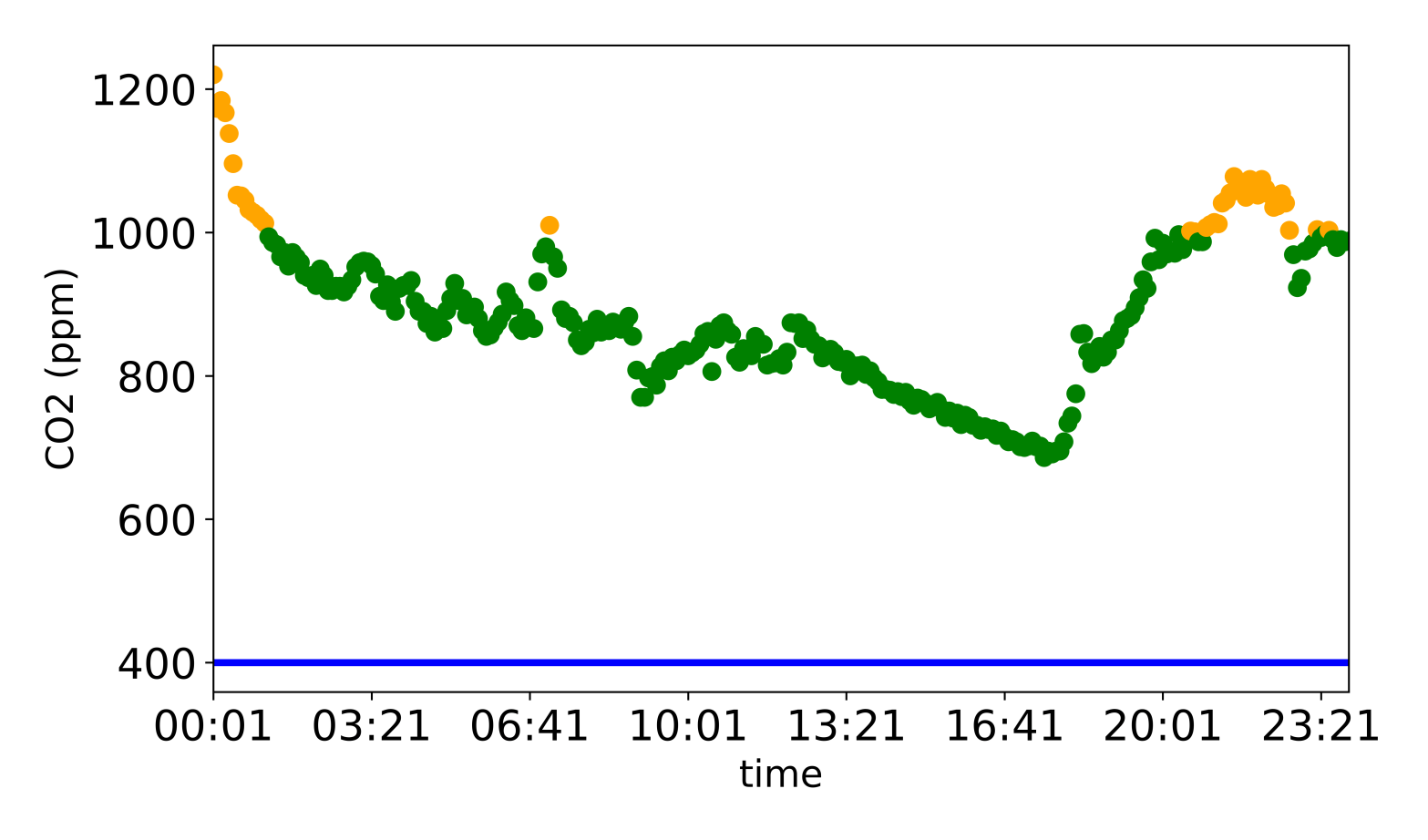
On Wednesday 14th December 2022 it was around freezing (0C) all day, and night. I worked at home in the morning to around midday, then was in work from midday-ish to five-ish. The plot shows the CO2 levels in my home for the 24 hours of that day, midnight to midnight. When I was home I kept small windows in my bedroom and kitchen open a few centimetres to keep some air turning over. As you can see from the plot, when I was at home the CO2 level was mostly between 800 and 1000 ppm (parts per million).
AI-powered chatbot that can be scarily good, can be just as bad as the World Health Organisation
A new chatbot called chatGPT* is making waves. Some of its answers are scarily good. For example:
Question: What is a phase transition?
ChatGPT: A phase transition is a change in the physical state of a substance, such as a change from a solid to a liquid or a gas, or vice versa. Phase transitions are driven by changes in temperature, pressure, or other physical factors, and they can occur in both pure substances and mixtures. For example, water undergoes a phase transition from a liquid to a solid (ice) when it is cooled below 0 degrees Celsius, and it undergoes a phase transition from a solid to a gas (water vapor) when it is heated to its boiling point. The study of phase transitions is important in many fields, including chemistry, materials science, and meteorology.
ChatGPT (4th December 2022)
A morning in the life of my personal ventilation status
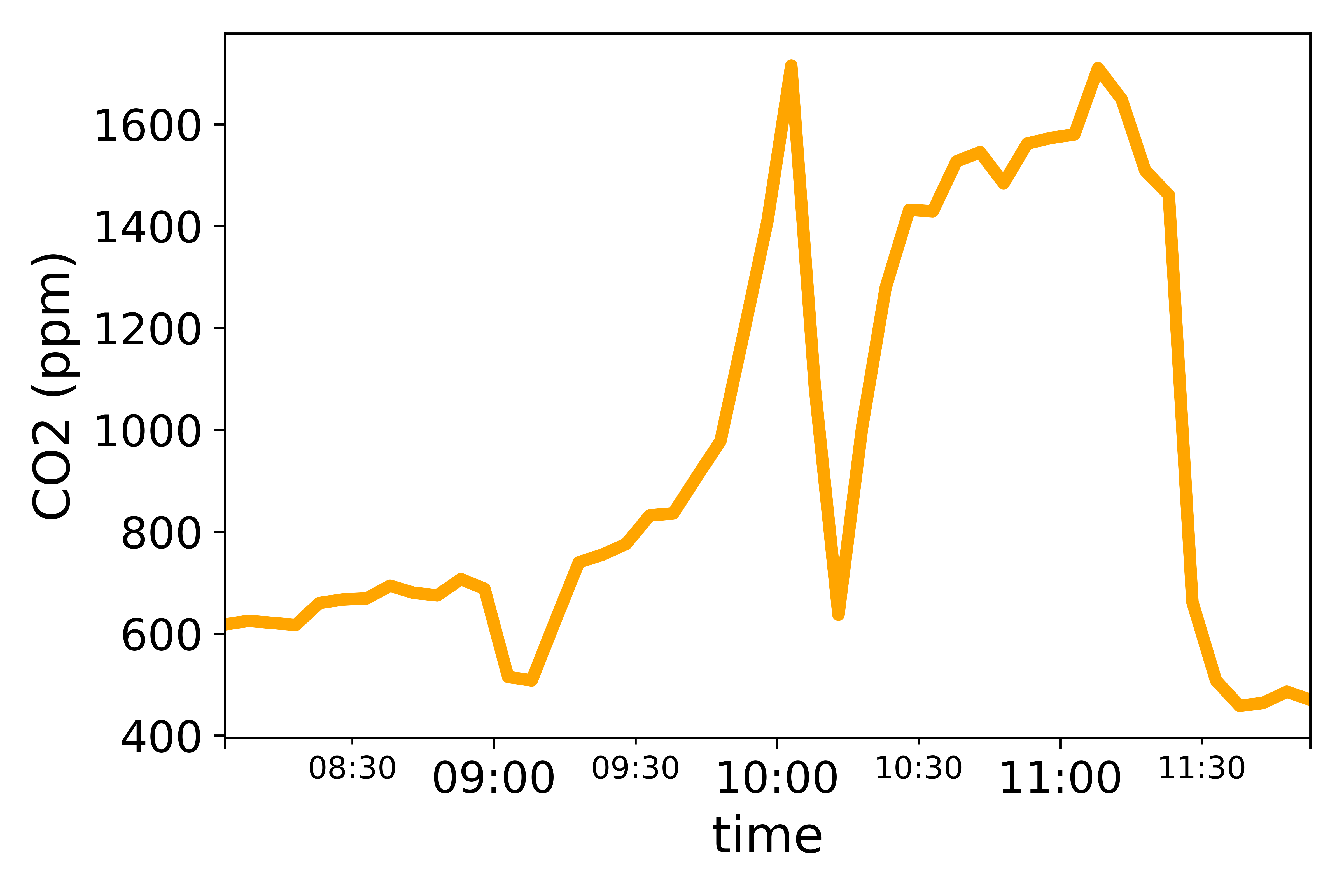
Yesterday I went to the University of Bristol to give a seminar, on some of the physics of COVID-19 transmission. It was great to see the people there and chat, and I took along a CO2 monitor so my seminar could include some real-time data on how well ventilated the seminar room was. It turns out that the ventilation was not that great, but I then opened a window in the room and it got better. I am sure many more intelligent and better delivered seminars have been given at the University of Bristol Physics Department. But they can’t be many seminars during which the seminar a potential health hazard was identified by the speaker, who then partially addressed it during the same seminar.

