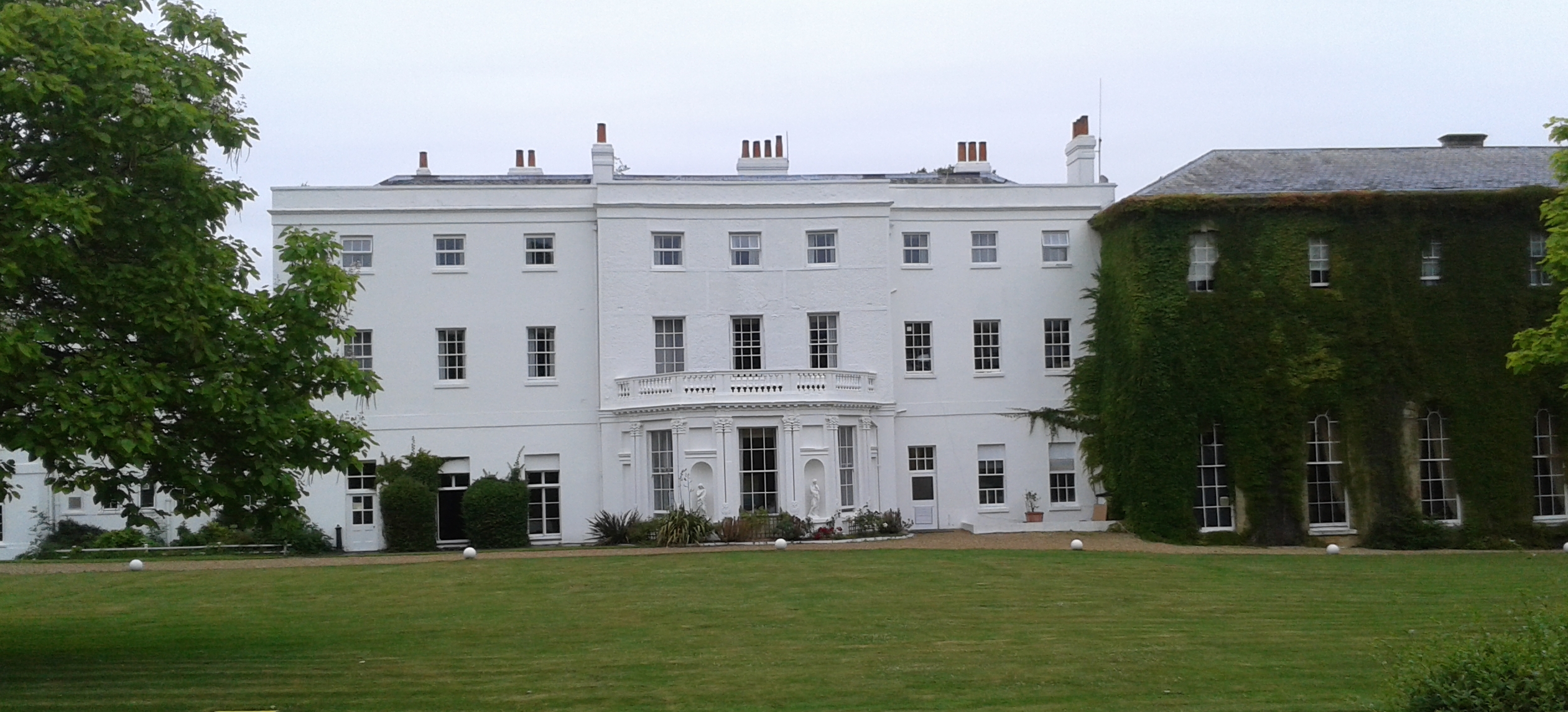
 Today I am at conference on metals crystallisation, next
Friday I will be co-chairing a workshop on structure in living cells. These are two of four back-to-back conferences will be attending over the next two weeks. With this many conferences it is good to have variety. This one is near Egham in Surrey, the picture shows part of the venue.
Author Archives: Richard Sear
Computational physicist at the University of Surrey. My research interests are in COVID-19 transmission, especially masks, soft matter & biological physics
Are less active chromosomes like WD40?
 We all have 46 chromosomes worth of DNA in each of our cells. Each one is kind of a stringy object that is typically around a few micrometres across, and all 46 are squeezed into a cell nucleus that is itself maybe only 7 micrometres across. These chromosomes are surprisingly variable. Chromosome number 18 has maybe 250 genes on it, while number 19 has around 1,500 genes, despite being around the same size*. So chromosome 19 is a lot more active than 18, many more proteins are being made from its much larger number of genes.
It has been known for a long time that the chromosomes are not uniformly distributed in the nucleus. The active ones, the ones like chromosome 19 with many genes, tend to be nearer the centre, while the quieter ones are near the edge. You can see this in image and schematic at top left, the less active chromosome 18 is at the bottom near the right end, while the more active chromosome 19 is above it and so away from the edge. The image is a from a paper by Bolzer et al.
Don’t get too excited
 What with high pressure penalties, last minute corners, etc, now is a good time to consider the Yerkes-Dodson Law. This is illustrated in the figure to the left. Basically it shows how difficult you find doing a task, e.g., taking a good penalty, is as a function of how much stress you are under/how much adrenalin is in your bloodstream. The y-axis says learning but is known to be more general than just learning.
For simple tasks (solid curve), the more adrenalin, the better, i.e., the more likely it is that you complete the simple task correctly. But for tasks where you have to think (see the dashed curve), it is not so simple. A bit of stress, a bit of adrenalin, helps, but too much hinders you, and the chance of you failing goes back up. There is an optimal level of pressure where you perform your best. Being half asleep is bad, but so is being panicked.
Eight days to impress 220 metal scientists, and my best model does not fit the data
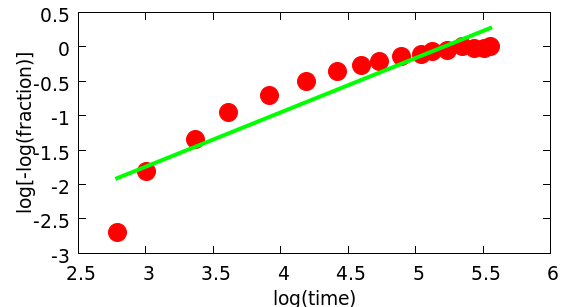 On Thursday I was quietly working in my office when a professor I don’t know, from Brunel University, phoned me. He is an organiser of next week’s 4th International Conference on Advances in Solidification Processes – a conference on metal crystallisation. One of their plenary speakers had bailed on them. He asked me to step in, so I said yes.
The Department where CDs never go out of fashion
 Today was the second of two back-to-back Open Days the University runs for prospective students. A-level students thinking of going to university in autumn 2015, and their parents, visit the university to learn about degrees and university life. Today we had about 350 to 400 visitors in the Department, and maybe a bit more than half than yesterday.
Direct from the Sun

As a scientist I guess I should stop and admire the beautiful natural world a bit more than I do. Too busy doing stuff most of the time, which is a poor excuse. Anyway, above is a picture of sunset over the river Seine in Paris. To the right you can see twin squarish towers, this is I think the Notre Dame cathedral.
A personal study of nucleation
I study nucleation, but mainly via modelling on a computer. The guy below, Harley Morenstein, took a more personal approach. Incidentally, if you are bored of the Vine looping just click on it.
Drinks like Diet Coke, lemonade etc, are carbonated, i.e., have carbon dioxide pumped into them under pressure to make them fizzy. If you carefully take the top off and are gentle with then (as opposed to giving them a shake) most of the carbon dioxide remains in the drink. This means that the amount of carbon dioxide dissolved in the water is actually above the solubility of carbon dioxide in water (at atmospheric pressure), and so this carbon dioxide wants out (technically speaking it is thermodynamically ‘downhill’ for the carbon dioxide to leave the water and go into the atmosphere).
The carbon dioxide comes out as bubbles and if the drink is not shaken these bubbles can find it hard to start to form. This initial step when a tiny bubble starts to form is called nucleation. If nucleation is not possible then this traps the carbon dioxide in the Diet Coke or whatever the drink is.
Until something comes along to make nucleation easier, like Mentos. Mentos are an American sweet, and for reasons nobody really understands, carbon dioxide bubbles nucleate like crazy on the surface of Mentos. So when the guy in the Mentos suit drops into the Diet Coke tub, bubbles of carbon dioxide nucleate like crazy, and you saw the result above.
Starve yourself, drink plenty of red wine, take statins, and listen to music, and you’ll never have a cold ever again!
A couple of weeks ago The Telegraph reported that: “Fasting for three days can regenerate entire immune system, study finds“. This sounds a bit like hard work to me, I have to say. I like food. Maybe you agree, if so we are in luck. Because, also according to the Telegraph: “Daily glass of wine boosts the immune system“. I have to say that that sounds a lot more like it to me. But what if you don’t like wine? Well, you are still in luck, because you can try taking statins: “Statins ‘could boost immune system’“. Don’t like drugs? No problem: “Music can boost your immune system“.
Believe first, ask questions later
Naively, you might think then when presented with a statement that is new to us, we start out not believing it, and then decide if we believe it or not. But apparently, it is the other way around. We have an inbuilt tendency to believe everything we are told, and only then afterwards do we check to see if it is true.
Is competition the answer?
Academia has always been pretty competitive. It took me about 2 years of looking to get a job as a academic, including a somewhat bruising and unsuccessful interview at Imperial (the question “Do you consider yourself a loner?” did rather throw me). And if anything 2 years is shorter than average. If you apply for a job as an academic you should accept that maybe 30 to 100 others will be applying for the same job, including some smart, hard working and ambitious people. But despite the pressure and work load, being an academic is still a good job, with a lot more freedom than most other jobs. And, as I tell my tutees “Good jobs are hard to get as the competition is strong, so you need to work on getting a good CV”, so you should expect getting a job as an academic to be competitive.
 Chance & Necessity