As a society we have become very dependent on antibiotics since penicillin was introduced 70 years ago. Before then healthy adults would die of sceptic shock from massive infection. We don’t want to go back to those days, and so we need to develop new antibiotics at least as fast as the bacteria in hospitals are evolving resistance to our existing ones*.
Author Archives: Richard Sear
Computational physicist at the University of Surrey. My research interests are in COVID-19 transmission, especially masks, soft matter & biological physics
Cancer may be mostly a matter of chance
This is the message of a paper by Tomasetti and Vogelstein, that came out last week. Unlike a lot of papers in Science it is beautifully written, with a simple idea and a clear message. They start with the simple observation that some cancers are much much more common than others. For example, the American figures they quote give a lifetime risk of cancer of the colon of 5%, and risk of bone cancer of the pelvis of 0.0003%. Why the difference?
My fellow scientists cite my work at random
Although the average number of times people cite my papers is lower than that for a Siamese cat, people do cite my work. And so Google Scholar reckons that at the time of writing my papers have attracted a total of N = 2858 citations and I have a h-index of 27. The value h of the h-index (named after Jorge Hirsch) is the number of papers that have been cited, i.e., referenced, at least h times. I have published 27 papers which have all been cited at least 27 times.
The science behind some of the few types of booze I didn’t drink over Christmas
 Over Christmas, as is traditional, I have been eating and drinking a lot. The drinks include beer, wine, dessert wine, liqueurs, etc, but no ouzo, pastis or sambuca. Ouzo, pastis and sambuca all have the distinctive flavour of aniseeed. While Googling something for a paper I am drafting I came across the explanation for why these drinks become cloudy when you add water. Ouzo for example is quite strong, about 40%, and so it is often diluted with water, but as soon as the water is added, the ouzo goes from clear to cloudy.
Titan, the one place in the Solar System where the Titanic could have cruised with impunity
 Pretty much everywhere on Earth where there is liquid water there is life. The biochemistry that powers our cells only runs in liquid water. In the Universe liquids are rare, like Little Red Riding Hood liquids are very particular, requiring conditions that are neither too hot nor too cold. Much of the Universe is near 0 K (-273 C), which is way too cold, or inside in stars at thousands of degrees, which is way too hot. Saturn’s moon Titan is at a refreshing – 180 C, which is too cold for liquid water, but methane is liquid at this temperature. The image to the left is of the surface of Titan and the dark regions are huge lakes of liquid methane and ethane.
Taller by degrees
 The plot to the left shows the distribution of heights of American women, ages 20 to 29, according to the 2007/2008 census. Data here. I couldn’t find data on UK heights, but it should be similar. Data for the heights of men are similar but shifted up a bit. The circles are the data and the line is fit of a Gaussian function to this data. The most probable heights are around 165 to 170 cm (5 ft 4 in to 5 ft 6 in). The width (standard deviation) of the Gaussian fit is 7 cm.
Shapeshifting to survive
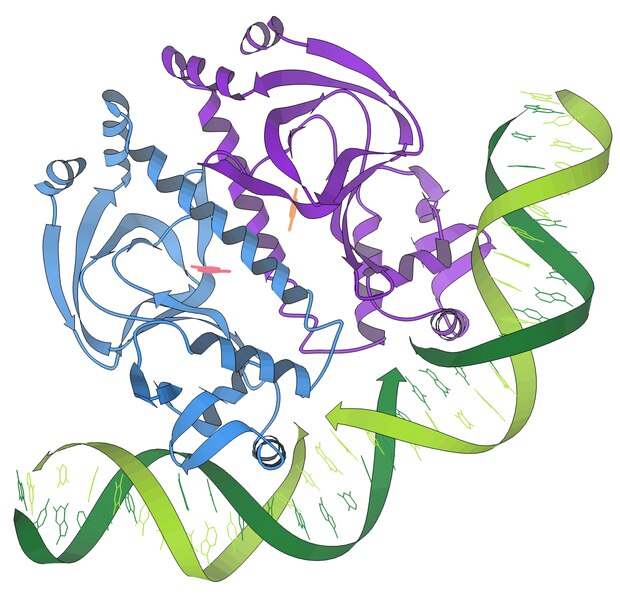 All organisms, from us to bacteria, need to adapt to survive. As I start to write this post, I have just had lunch and so I guess my blood sugar is probably peaking nicely. Some of this sugar will need to stored for later consumption, and doing this will involve flipping switches in my biochemistry to go from my pre-lunch state of burning food reserves to storing excess calories from my lunch.
In a dog-eat-dog competitive world, I lose to a Siamese cat
 In a post on Surrey’s blog I boasted that I was twice as good as a hamster, according to one common metric for measuring the achievements of an academic scientist. However, I am sadly not superior to all furry mammals, a cat beats me, by that same metric. I average out at about 28 citations per paper I have published. F.D.C Willard*, who was a cat, averages out at 34.
Blondes and the KITLG gene
 This Friday I am teaching an introductory lecture on genetic switches, so I had a look around on the web for topical examples. My favourite is recent work by Guenther, Kingsley and others in Stanford on work on the genetics of blond hair. Of course we know what blond hair must be determined by our genes, blond parents tend to have blond children. But we are still working out what are the genes involved. Amongst our twenty-odd thousand genes is KITLG, which like a a lot of our genes is involved in a lot of different things, including how our bodies make blood, and whether we have blond hair.
Almost enough to make me take up smoking
In the biological physics course I am teaching, I talked a lot about the fact that on lengths greater than around a tenth of millimetre, diffusion of molecules is too slow to supply the needs of living organisms. To get round this they had to evolve pumps, propellers and cargo transport infrastructures. The time to diffuse a distances increases as the square of the distance travelled and so diffusion is slow on all lengths large enough to be visible to the human eye.
 Chance & Necessity