
As a 50-year-old guy I find it a bit weird to recommend a YouTube channel, but I am going to recommend Aaron Collins’ YouTube channel on masks*. Back in Spring/Summer 2020 we were (rightly I think) urged to avoid the sophisticated masks used by healthcare workers, because there was a shortage of these masks and these frontline workers needed them more. But now there is no shortage, so we should wear the best mask we can. See Aaron Collins’ channel for him testing masks and recommending the best masks. Not all masks are the same, some offer much more protection than others. The filtration properties of cotton fabric are generally pretty poor (colleagues and I have a preprint on that), but the best masks are made from sophisticated filtration medium which is much much better.
Author Archives: Richard Sear
Computational physicist at the University of Surrey. My research interests are in COVID-19 transmission, especially masks, soft matter & biological physics
Welsh independence seems to mean independent of the scientific consensus
Although I have been at Surrey for over 20 years I grew up in South Wales, where my mother still lives. In fact she lives in the Neath Senedd constituency of the Welsh government’s Minister for Education, Jeremy Miles. The Welsh government, under Jeremy Miles has had a bit of a brain fade and planned to introduce ozone machines into Wales’ classrooms. These don’t work, essentially because ozone is toxic so you can’t run machines while children and teachers are in them. But as the virus is breathed out by infected people, you have to purify or refresh the air while people (including possibly an infected person) are actually in the room. Running an ozone machine at 7 am in an empty classroom is a waste of everyone’s time, and protects no one.
If you know what you are doing you get the same result from a 1940s differential analyser and a modern computer running Python

Above is an aircraft wing which has picked up ice on the leading edge of its wing. This is of course is not ideal, especially for an aircraft in the air. You don’t want large amounts of ice forming along the leading edge of the wing in flight, it will add weight and make the wing less able to generate lift. I think there were particular worries about this during the Second World War, possibly because planes were flying higher and faster as the war drove rapid advances in aircraft design and performance. So the United States Army Air Force turned to the dream team of a Nobel-prize winner, Irving Langmuir, and the first woman to obtain a PhD in physics from the University of Cambridge, Katherine Blodgett. They worked to understand the following problem.
Teaching in the new COVID times
Gavin Williamson, the Secretary of State for Education and so my boss has been sharing his opinions on the coming university academic year. One thing he said that I agree with is
Parents would find it “odd” if students could go to other social activities but were not allowed back into lecture halls, the education secretary told the Universities UK conference.
Students may also find it odd, if they can cram into a nightclub, but are asked to socially distance in a lecture theatre, which has a reduced seating capacity due to University-imposed COVID-19 restrictions.
California or Florida, which example do we want to follow for our schools?
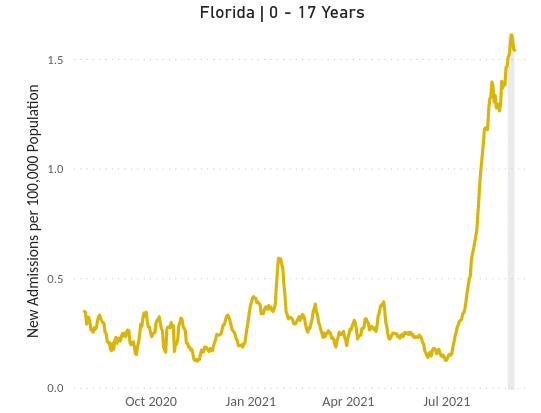
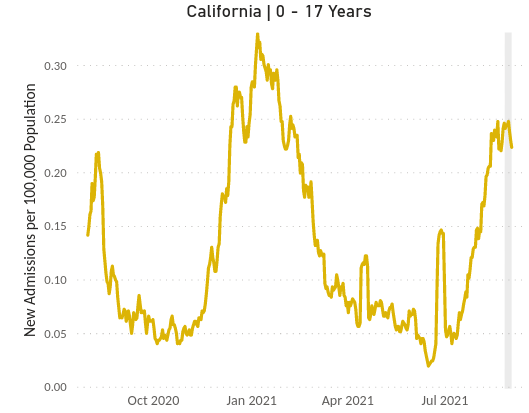
Above are the numbers of admissions of children to hospital per day, due to COVID-19. The numbers are per 100,000 of the population, from CDC’s COVID-19 dashboard. On the left is data for the American state of Florida, on the right is for California. It is very important to note the different scales of the y axes! The scale for the California plot maxes out at 0.3 per 100,000 while Florida’s scale goes up five times higher, to 1.5 per 100,000. As I noted in an earlier blog post, the American school year starts earlier than in the UK, around mid-August depending on the school. American children have been back in back in classes for two or three weeks now. And the effect is easy to see, at least in Florida.
Teaching meets COVID-19 research
Semester is starting to loom large, lessons start in four weeks. I will be teaching several things, including biological physics – a course where I also try and blend in some learning of estimation. Of course, for biological physics I currently have no shortage of real-world examples. So let’s look at one that involves some estimation. Question: If Guildford’s nightclub Casino is full to capacity, what is the probability* that none of the patrons are asymptomatic carriers of COVID-19? Casino’s capacity is 1,500. ONS data on the fraction of the population that are infected is here. A reasonable estimate for the fraction of people infected with COVID-19, that do not know it, is somewhere in the range say one in five to one in three.
The problem is that people are prepared to pay for the cherry, but they won’t pay for the cake
The title is a quote from the excellent Vaxxers by Sarah Gilbert and Cath Green, on how they led teams to develop (with others and with AstraZeneca) the Oxford-AstraZeneca vaccine, and to bring it into use to vaccinate millions, including me. It is very readable, as well as being an inspiring read. If you are looking for your next book, I strongly recommend this one. The quote is from the final chapter, and I think it is worth quoting some more from that chapter:
Academic vaccine projects that attract funding are almost always to make a vaccine for a specific disease, not to do the underpinning work on more general improvements …. This work could have cut months off our response time, and the amounts we were asking for … look laughably tiny compared with the hundred of billions we have had to spend on fighting this pandemic. … [A] significant chunk of the UK funding … has come from the UK’s Official Development Assistance budget – a budget that has just been cut.
I recognise and sympathise with the frustration that vital underpinning research can be almost impossible to get funded. In many cases over 90% of attempts to get funding being rejected and funders often want you to show how-paradigm-shifting etc is your research. But many processes that we rely on, from making vaccines to rubber gloves, have parts that are poorly understood and done at the moment in a rather empirical way. This is partly because no funding body is interested in funding work to understand how they work, and so make them work better and faster.
It is better to learn from others mistakes, than to blindly repeat them
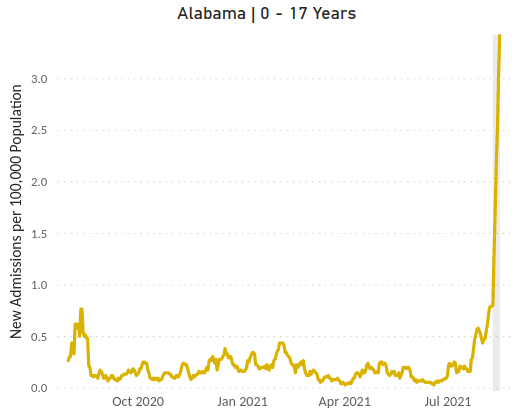
Above is a plot of the number of children being admitted to hospitals in the American state of Alabama, due to infection with COVID-19. This is per day and per 100,000 of the population. To put it into context, the population of England is about 56 million, so three children admitted to hospital per 100,000 is about 1,500 children admitted to hospital each day. The data is from the American Centres for Disease Control COVID-19 dashboard. Note the over 300% rise in hospital admissions in the last week. In the USA school starts earlier than in UK, I think term starts in Alabama in early/mid-August. As you can see, the consequences of the schools reopening on transmission of COVID-19 among children, is dramatic. Many schools in Alabama don’t require masks, I guess many of them are not taking action on ventilation. The Delta variant of COVID-19 is very contagious, and so if you crowd unmasked children together in poorly ventilated classrooms, you get what you see above.
Are infected hamsters really so much more dangerous?
I’m reading a preprint by Hawks and coworkers. They used controlled lab experiments with hamsters to show that when infected the hamsters breath out infectious SARS-CoV-2 — the virus that causes COVID-19. This is in small (less than 8 micrometres in diameter) droplets, that can travel several metres across a room. This result is not a surprise but it is good to show this. Surprisingly, given how contagious COVID-19 is, showing definitively that you have infectious virus is technically very challenging, so it is good to see it being done. It confirms that we can catch COVID-19 from an infected person that may be across a room from us, and so social distancing by a metre or two may reduce the risk, but does not eliminate it.
The number of secondary-school age children infected with COVID-19 has tripled in a month, so is it time to abandon social distancing and masks?

 Chance & Necessity