The problem of a long filamentous virus like Ebola surviving, or not surviving, the violent process of becoming airborne, is complex. I always think it is best to start simple, so we need to simplify the problem.
We can simplify both the forming droplet, and the virus. The droplet likely shears off from a sheet or similar of liquid, and then undergoes some rather complex shape changes before surface tension pulls it into a sphere. But we can just consider a deformed sphere. The problem of flows around nearly spherical liquid droplets was studied way back in the nineteenth century by Horace Lamb. If something is not far from a sphere then we can use the right functions to study this, which are spherical harmonics.
In spherical harmonic treatments of flow inside deformed spheres, the leading order term is the quadrupolar, or l = 2, term*, with cylindrical symmetry. This is a deformation given by the second Legendre polynomial P2(cos(θ))=(1/2)(3cos2(θ)-1), where θ is the polar angle, the angle to the z axis
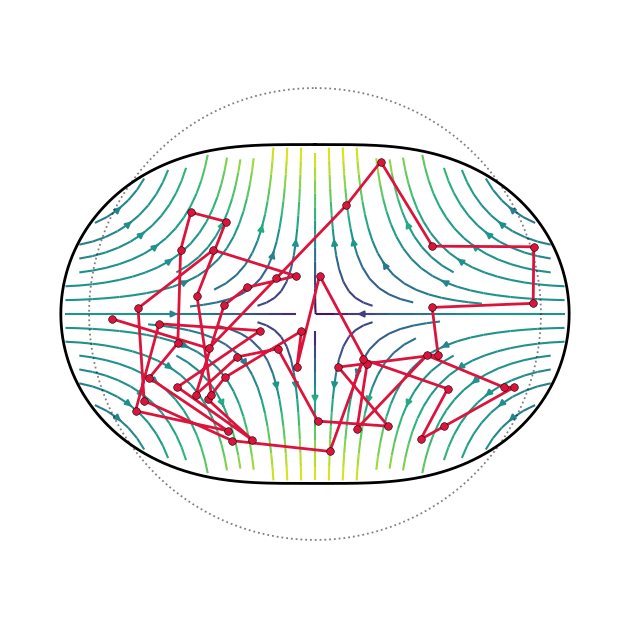
This says that at an angle θ the surface of the droplet is a distance rs away from the centre of mass at the origin. A cross section through a deformed sphere of radius R, with deformation strength ε = -1/4, is shown above. A negative ε gives a squashed sphere, a positive ε gives a sphere stretched along the z axis (vertical axis above).
At the start ε = -1/4 and it decays exponentially to zero, as the deformed sphere relaxes to the equilibrium shape, which is a perfect sphere. I am assuming Stokes flow, so assuming that inertia is negligible** – so droplet just relaxes back to a sphere. You need inertia to get an wobbling of the sphere.
The flow field is shown by the streamlines. As you should expect for an initially oblate object relaxing to a sphere, the flow is in to the centre along the horizontal axis as it contracts along this axis, but out from the centre along the vertical axis, as the droplet expands along that axis.
So this is about a simple flow field as you can get for the system of a relaxing droplet. The polymer model is also very simple – and so likely I think a poor model of a filamentous virus. It is just a Rouse polymer model: a set of N (noninteracting) diffusing monomers (shown as red circles) connected by springs (red lines).
With such a simple model, I am not sure that we can say much about what happens to a filamentous virus in a forming aerosol droplet. But one thing is notable. The timescale for a Rouse polymer of N monomers to relax along its entire length is
where a is the root-mean-square (RMS) monomer-monomer separation, ζ is the drag coefficient for a monomer, T is the temperature and k is Boltzmann’s constant.
The Rouse model should not be too bad for single-stranded DNA, this is very flexible (unlike double stranded DNA) with effective monomer length of a ~ 1 nm, and a drag coefficient of roughly ζ ~ 10 a η ~ 10− 9 Ns− 1 m. The viscosity of saliva/mucus varies a lot, I use a value 100 times that of water at η = 0.1 Pa s, but this value is a bit of a guess.
Even for a relatively short DNA polymer of 1000 monomers, the relaxation time is of order 10 ms. This is orders of magnitude longer than the time for an aerosol droplet to relax, so the polymer will feel the droplet formation process as a short sudden shock. The polymer is jerked out of shape and then relaxes back to its new environment, long after the aerosol droplet has formed. As at most one or two of the monomers touch the droplet surface at any one time, this force is mainly that of the flow field. I think its likely that, at least for larger polymers, this force is large enough to pull them apart, as the polymers were in the shearing system of an earlier post.
* The l = 0 term corresponds to changes in volume, and as liquid water is pretty much incompressible, we don’t have to worry about that one. The l = 1 term corresponds to the droplet moving, and that should not affect the virus.
** When inertia is negligible then the speed of flow u is set by the competition between surface tension Gamma and viscosity eta, in fact the scale of the flow is just the ratio Gamma/η which maybe close to 1 m/s. The viscosity of the viscosity of saliva/mucus varies a lot, I use a value 100 times that of water at 0.1 Pa s, but this value is a bit of a guess. This is very fast! One consequence of this is that inertia is only negligible for surprisingly small droplets. The contribution of inertia (relative to viscosity) is given by the Reynolds number Re = uR / ν with ν ~ 10−4 the kinematic viscosity of saliva/mucus. This gives Re ~ 104R. So inertia should be small for droplets a micrometre across, or smaller, although this estimate is sensitive to my guess at the viscosity of saliva.


