It is well known that very long DNA is vulnerable to being pulled apart. For example Joneja and Huang showed that initially much longer DNA fragmented into lengths of a few kilobases (about a micrometre) long, when the solution was repeatedly pushed through 0.5 micrometre pores. The flowing solution has to channel in to the pores and then spreads out on the other side of the pores, and in both cases this creates shear in the solution. It is easy to simulate a simple model of this, which is what the video shows.
This is not a great model of DNA, it is just 30 beads held together by 29 springs into a chain that diffuses via what is called Brownian dynamics. I just simulate it for a while, then apply a shear flow field to it. This flow field is a velocity from left to right that increases with height, i.e., is faster at the top than the bottom.
When the shear field is switched it, it stretches the polymer out along the velocity direction, because the shear acts to rotate the polymer to lie along the flow. But even then note that the right-hand blue bead is higher than the left-hand one. This means the right-hand one is being pulled faster than the left-hand one, which puts the polymer under tension. This is why the polymer is a lot longer than it was before the shear was applied.
The same forces are pulling on the bonds that hold the polymer together. And these bonds can break. Real chemical bonds break under forces of about a nanoNewton (nN). This force scale is just the ratio of the energy of a chemical bond, around a electronVolt (eV ~ 10− 19 J), to the length of a chemical bond, around 0.1 nanometre (nm).
In my model I just put in a breaking force for a bond and then run the simulation. As you can see the polymer breaks, and it breaks near the middle. This is expected, the forces on the bonds are largest nearest the centre: bonds at the centre have the sum of the half of the monomers to their left pulling to the left, while those in the right half pull to the right. The result is this distribution of tensions in the bonds:
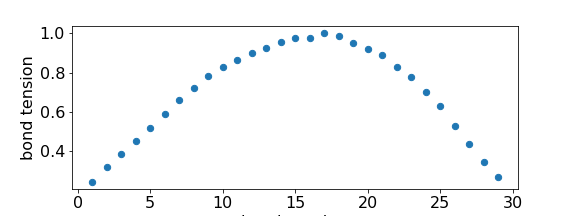
The tension in a bond is normalised by it’s maximum value. Note that the tension is a nice parabola with a maximum tension at the midpoint of the polymer – so it is most likely to break there. And breaking near the middle is just what the movie up top shows.


1 Comment