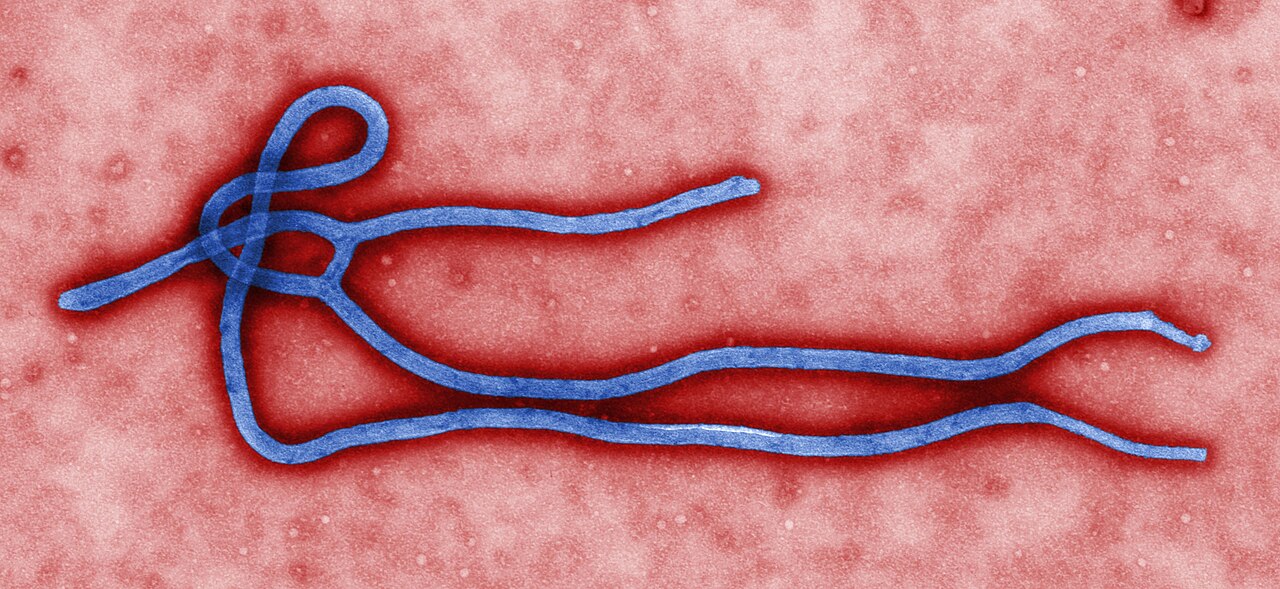
It may be that the deadly Ebola virus* is only very inefficiently transmitted across the air, in aerosols. If so, then I am not sure anybody knows why. But we can speculate. The formation of aerosols involves very short lived (much much less than a second), but very fast (metres per second) flows, as the aerosol droplet’s surface tension pulls the newly formed droplet into a sphere. These shearing forces can potentially damage viral particles, destroying them just as they become airborne in an aerosol droplet, and preventing their transmission across the air. These shearing forces may (or may not?) be much more dangerous to long filamentous viruses such as Ebola, than compact spherical viruses such as SARS or flu. Ebola – see image above – has viral particles that are over 10 micrometres long and filamentous. SARS and flu viral particles are roughly spherical and around 0.1 micrometres in diameter.
Viruses have not been carefully studied in shear flow, but the long filamentous double helix of DNA has been, including in some lovely careful work by Jiang and coworkers. They study steady state shear forces and the simple (but unrealistic for aerosol droplet formation) problem of simple elongational flow, in a microfluidic setup.
Their set up traps a DNA double helix of length L with its centre point at the stagnation point of the flow. For a stagnation point at the origin then the x and y flow velocities have the simple form ux = γe x and uy = − γe y, for γe the rate of elongational flow. Then if we model the DNA as a rod along the x axis, the shearing induces a tension along the DNA of
for l the distance along the DNA double helix from its centre point, η the viscosity of the fluid, and a a dimensionless constant that Jiang and coworkers estimate to be 0.60 for their DNA**.
Jiang and coworkers study DNA that is tens of micrometres long in elongational flow rates γe of order one, in a solution that is made around 50 times as viscous as water, so η ~ 0.05 Pa s. This gave tensions varying from pN up to of order 100 pN, at its highest point in the centre of the DNA.
This is enough to significantly stretch the DNA, by tens of %, but the DNA does not break. Each strand is held together by covalent bonds that need forces of around a nN or 1000 pN*** to pull apart.
The study of Jiang and coworkers is a particularly elegant and simple one, where they keep the geometry as simple as possible. Aerosol droplet formation is much messier, the flow is not simple elongational flow and varies rapidly both in space inside the forming droplet, and in time, as this is a very fast process.
In particular many aerosol droplets are less than 10 micrometres across so any Ebola virus particle cannot be stretched out along a line, it has to be at least partially curled up. But even so, if even a micrometre length of it is near a sheared layer in the surface of a micrometre droplet then as shear rates of 107 s-1 are possible (but only very transiently****), and for droplets of mucus with the same viscosity of water, this is still a tension of 10 nN. A tension of 10 nN is probably enough to pull an Ebola virus particle apart.
But this estimate of 10 nN is extremely rough, it is a big jump from Jiang and coworkers’ elegantly simple question to a filamentous virus in a forming aerosol droplet. A lot more work is needed here to get credible estimates.
** An interesting point to note is that the tension in a long thin rod in flow has almost no dependence on the radius of the rod.
*** The nN scale to pull a covalent bond apart is just the bond energy of an eV over the bond length of 0.1 nm.
**** I am assuming that when shearing starts/stops, any tension applied reaches steady state very quickly, this may not be correct ….


