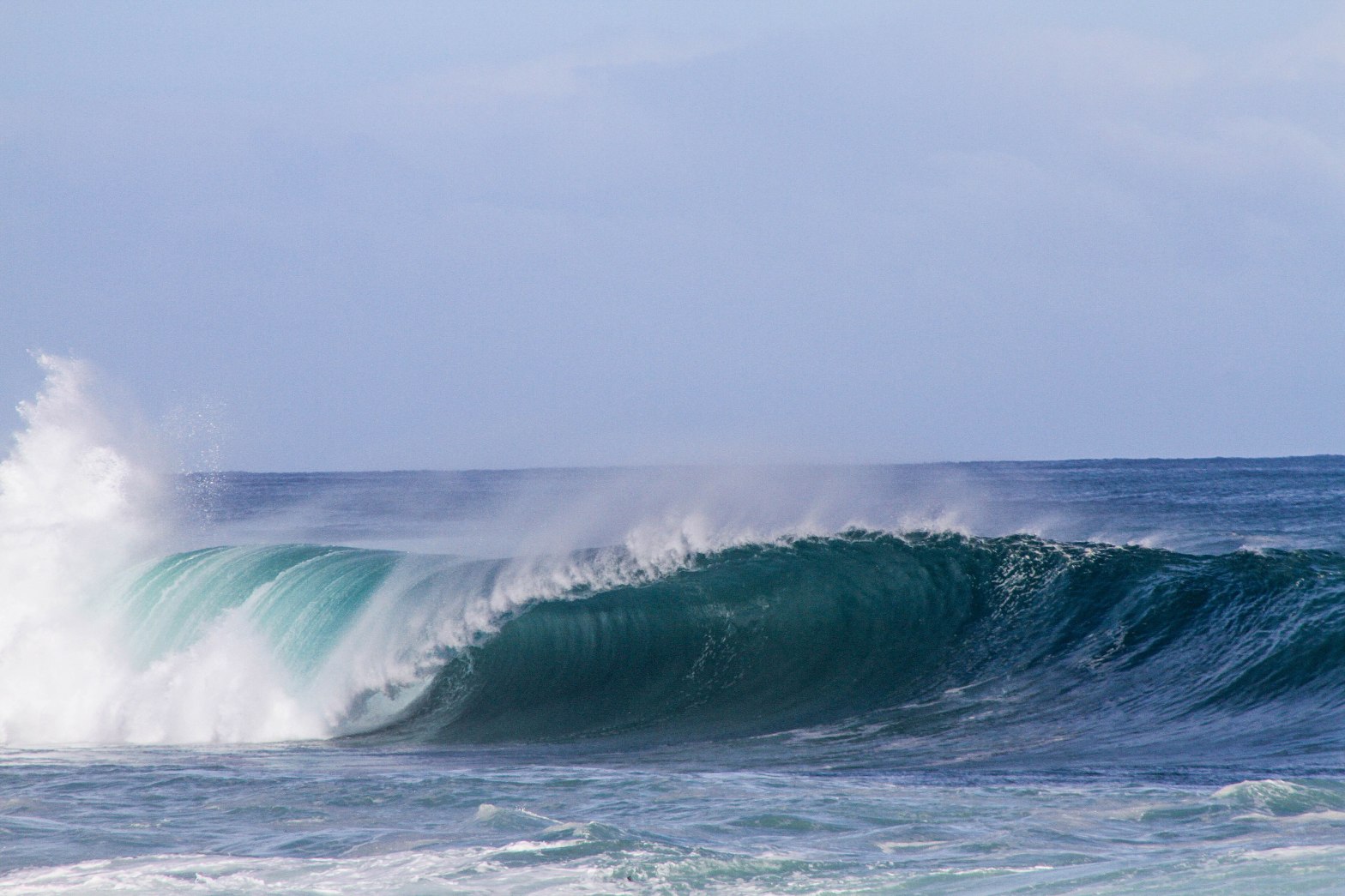
A respiratory virus like flu or SARS-CoV-2 (the cause of COVID-19) begins its journey to infect a new person by leaving the mucus-covered throat or lungs of an infected person, and becoming airborne in tiny droplets*. The infected person then breathes out these droplets containing their cargo of airborne infectious virus. This process of the virus leaving the liquid lining our lungs, throat and mouth, in small airborne droplets – an aerosol – is poorly understood. Viewing tiny, perhaps a micrometre across, droplets deep in our lungs, is impossible. But the formation of these aerosols obeys the same physics* as the formation of another aerosol – sea spray – shown in the image** above.
And we have some ideas on the physics at play. Droplet formation is opposed by the surface tension of sea water/mucus, Γ, which we know is a bit less than 0.1 N/m. As a droplet breaks off – from a wave or from a transient sheet of mucus in you vocal cords – then it is surface tension that forces the droplet into a sphere. To change shape requires that the liquid in the droplet flows, which creates shearing forces. Question then is: Do these shearing forces tear at least some of the viral particles apart? Or not.
The first thing to note is that the flow speeds in these small droplets are surprisingly large. The forces from surface tension rounding up the droplet are so large that even for micrometre-sized droplets the flows are so fast that it is mainly inertia not viscosity that resists the surface tension forces.
The competition of inertia and viscosity in resisting flow is measured by what is called the Ohnesorge number***
where η is the viscosity (saliva is only a bit more viscous than water, at around 1 mPa s), Γ is the surface tension (about 0.05 N/m), ρ is the mass density (1000 kg/m3) and d is the droplet diameter. An Ohnesorge number less than one means that the forces of surface tension are mainly opposed by inertia, with viscous forces less strong.
When the flow velocities are set by the competition between surface tension and inertia, we can estimate the scaling of the flow velocities just from Newton’s famous F = ma equation. Here this is
where the left-hand side is the surface tension force F = Γd on the droplet surface, and the right-hand side is the mass m = ρd3, times the acceleration which I write as the flow speed u divided by the flow timescale d/u. Rearranging we have the flow speed
which as the flows have to move liquid over a distance d to change the shape of the droplet implies a capillary-inertial timescale**** of
These are fast moving flows over a short timescale, and as inertia dominates viscosity, the forming droplet will wobble (undergo shape oscillations) a few times before it settles down.
Now I think (but am not sure) that for droplet formation at these Ohnesorge numbers less than one, most of the shearing occurs in a boundary layer***** near the droplet surface. This boundary layer has thickness
with ν = η / ρ the kinematic viscosity aka the diffusion coefficient of momentum. So the boundary layer is about a tenth of the droplet thickness, for micrometre droplets. Then the velocity (shear) gradient across this layer is
with a corresponding shear stress
and the power dissipation is
which was studied in 2021 by McRae, Mead and Bird who used numerical calculations to confirm the scaling of the power dissipation with d******.
So, after this we conclude that: As an aerosol droplet 1 μm in diameter is formed, any virus particles relatively near the surface will experience a shear rate of around 107 s−1, with corresponding shear stress of 104 Pa and energy dissipation of around 1012 W/m3. Virus particles near the centre should feel much smaller shear rates, stresses and dissipation.
Unfortunately, I am not sure I have a good idea of what shear rate/stress/dissipation rates are high enough to destroy viruses. Not sure if I even know which of the three quantities is the one that is useful to understand any damage shearing may be able to inflict on viruses. That would require a model for a viral particle….
* See for example the 2023 review of Pohlker et al..
** Image from Wikimedia and by Jeremy Bishop.
*** See the 2022 review by Detlef Lohse for an introduction to the dimensionless that help us understand droplet formation.
**** Here capillary means from surface tension.
***** This boundary layer looks like it is related to the (simpler classical case) of a Stokes boundary layer.
****** The numerical calculations, Figure 3 of McRae et al., show that the median power dissipation scales with diameter as d−5/2. As the fraction of the volume of a droplet that is within the sheared boundary layer decreases with increasing d, I am bit surprised that their median (over the whole droplet volume) value has the same scaling as I find in the (shrinking with increasing d) boundary layer. Although the ratio of the thickness of the boundary layer to the droplet diameter only varies as d−1/4, which is a very slow variation with d, so maybe over all or almost all of the d range McRae et al. investigated, at least half of the droplet volume was shearing?


.jpg)
2 Comments