I have been reading both students’ final-year-project reports and a report commissioned by the NHS. I don’t know whether to be happy or sad that some of our students can write better reports than an august panel that includes a number of members of Royal Colleges. On the one hand it is great to see our students doing so well, but on the other hand at any one time the NHS is treating millions of patients, and you would hope that infection control in NHS hospitals would have rather more competent oversight.
Doctors criticising other doctors in the COVID-19 pandemic
The British Medical Association (BMA) – the body that represents medical doctors – is producing reports on the COVID-19 pandemic, in consultation with their members. The first report is How well protected was the medical profession from COVID-19?. Summary here. As you would expect, it makes pretty grim reading and repeats the (well founded, I think) criticisms of the UK government’s response, such as inadequate PPE.
Carbon dioxide levels in your home & you

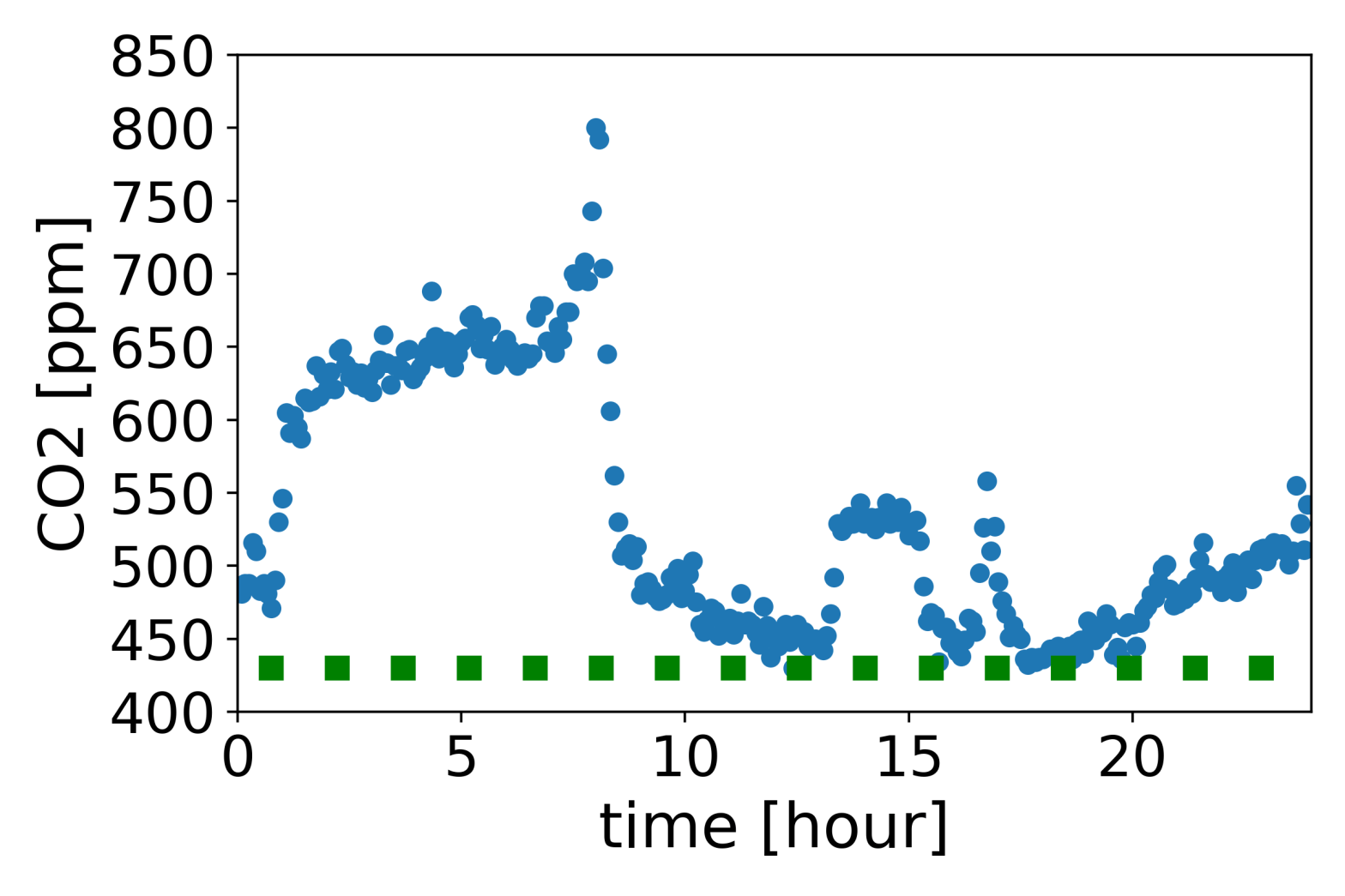
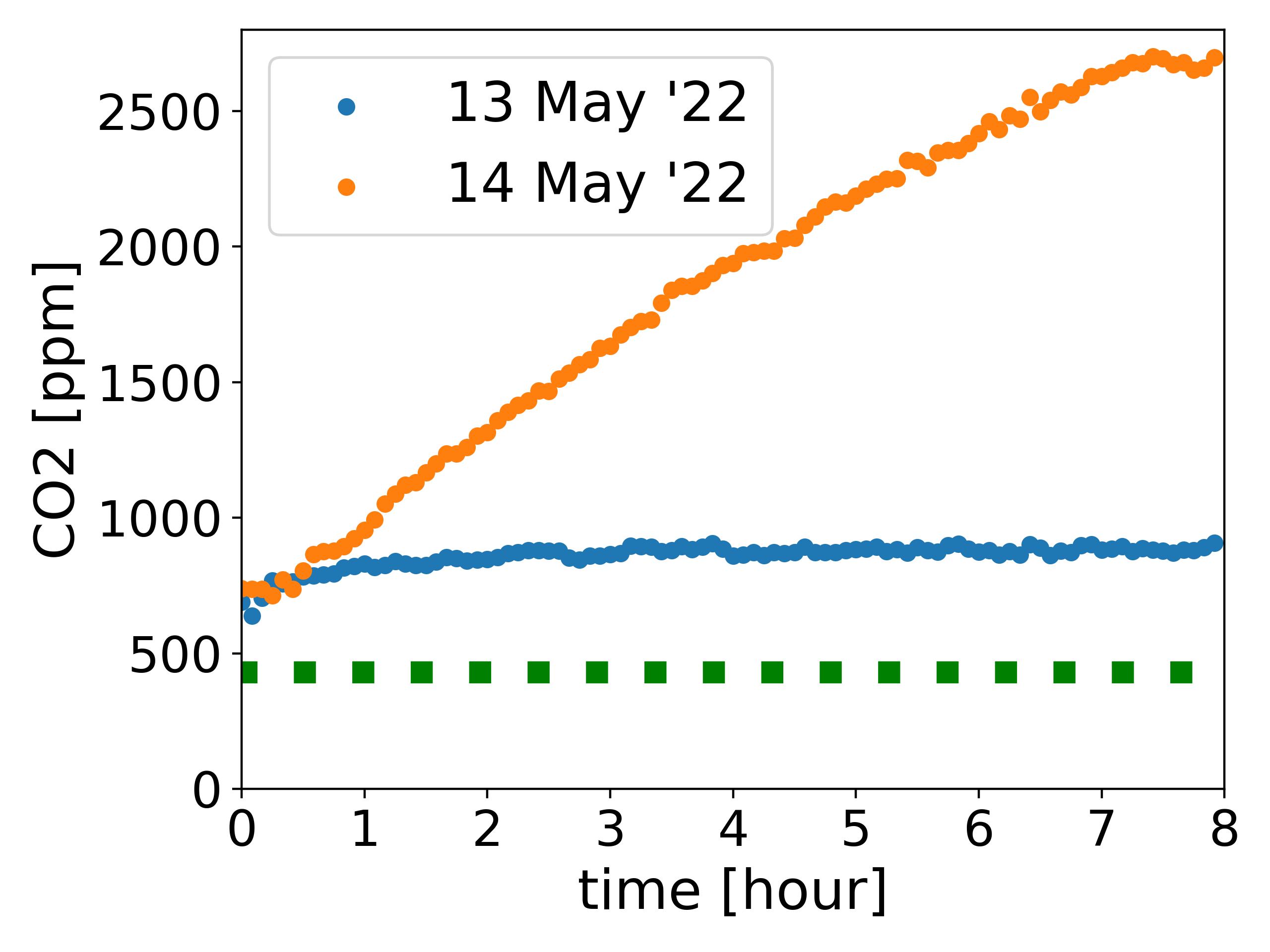
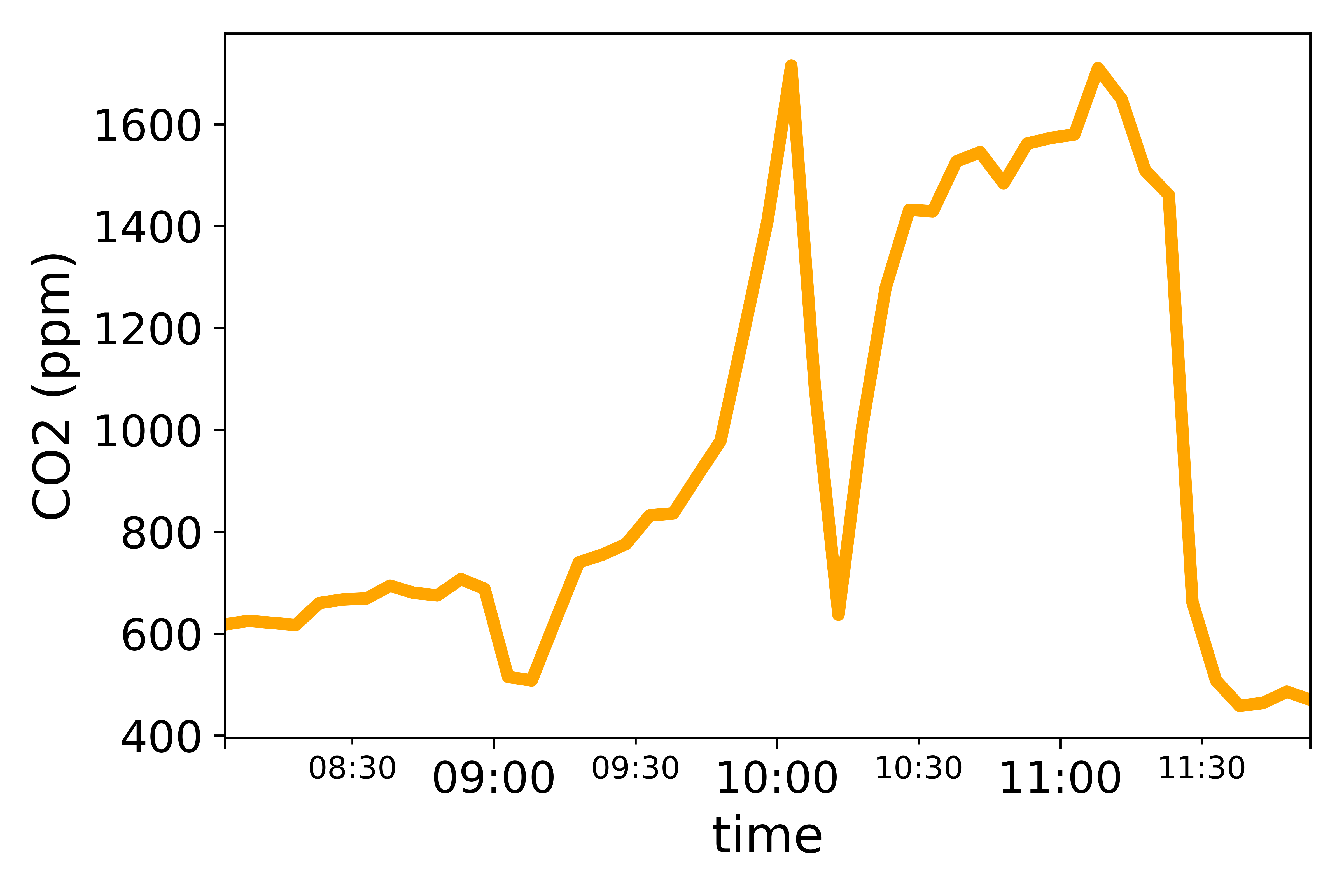
Teaching is now almost finished for this academic year. On Friday I had my last meeting with one of my project students. It was nice, he has learnt a lot and we said we’d next meeting at graduation in July. So I have a bit more time, and a new toy: a CO2 meter*. This measures the carbon dioxide aka CO2 in the air. The concentration of CO2 in the Earth’s atmosphere is about 400 ppm** – where ppm = parts per million. Out of every million molecules in the atmosphere, 400 are CO2. There is some evidence – although I am not sure it is very strong – that at CO2 levels above 1000 ppm your brain functions a little less well. In any event, CO2 levels allow you to estimate how well ventilated a room is.
Quantifying the benefits of a well-ventilated room

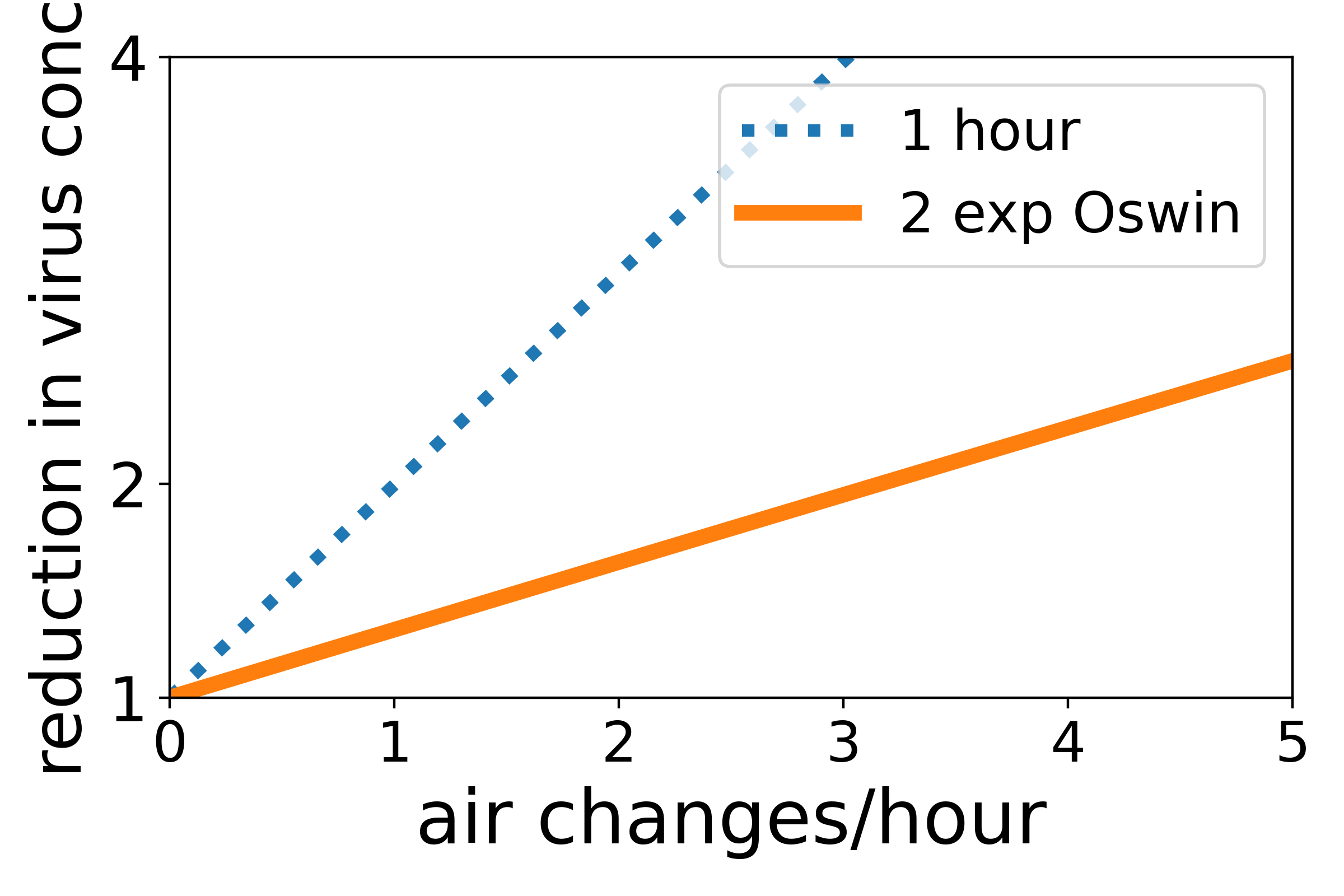
Quantifying the absolute value of the risk of catching COVID-19 is very hard, not least as it seems likely that some infected people may be breathing out a million times more virus, than others. But estimating changes in risk is a bit easier, eg a reduction in risk due to ventilating a room. If we make some assumptions (see below), we can estimate the reduction in exposure to the virus, due to ventilation turning over the air in a room. This is plotted above. The y-axis is the factor by which exposure is reduced, i.e., two means that the exposure is halved, and so on. The x-axis is the number of times an hour ventilation replaces the air in a room. So two means the air in a room is replaced by fresh air twice an hour. The solid orange line uses (a fit to) data of Oswin and workers on the how long SARS-CoV-2 survives in the air. The prediction is that turning the air over three times an hour approximately halves the exposure to virus.
Is it best to sleep with a window open at least a little?

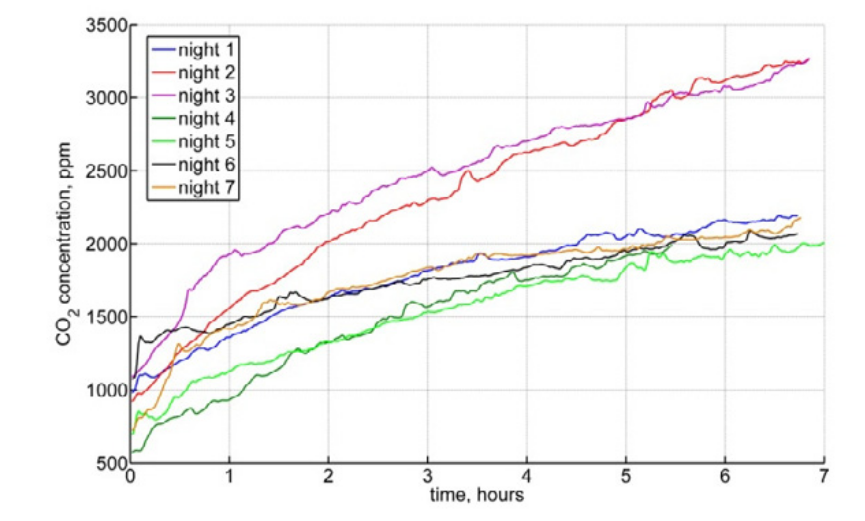
Above is a plot of the concentration of carbon dioxide (C02) in a bedroom in which one person is getting about 6.5 to 7 hours of sleep. Plot is as a function of time from when they go to bed to when they get out of bed, and is from a 2013 paper by Batog and Badura. The units are parts per million (ppm). For context, the atmospheric CO2 concentration is about 400 ppm, i.e., in the Earth’s atmosphere (i.e., outside our homes) out of every 1 million molecules, 400 are carbon dioxide*. In our homes and offices, the CO2 concentration is higher because we are all breathing out CO2. We breathe in oxygen (O2), use it to burn our food for energy, then breathe out the CO2 this produces. As far as I know, there are basically no set limits on CO2 concentrations but guidance for workplaces, schools, etc is typically that it should be no more than a 1000 ppm. As you can see, this concentration is exceeded for most of the night.
Avian influenza A subtype H7N7 has killed one person, and is classified as a “High Consequence Infectious Disease”. COVID-19 has killed 10 million, and is not
A year ago I wrote – with some surprise – of the UK government’s decision to downgrade the classification of COVID-19, so that it was no longer considered a “High Consequence Infectious Disease” (HCID). This was done right at the beginning of the pandemic in the UK, spring 2020. Very early on, COVID-19 was classified in this most-dangerous HCID category, but it was then downgraded. But I don’t think I was surprised enough.
Infection control guidance that begs a lot of questions
During the pandemic we are all living through, vaccines have been a triumph of scientists and medics. Vaccines have saved millions of lives, and we should all be grateful to the medics who have played their part in this. By contrast, the senior medics responsible for infection control in hospitals have, in my opinion, had a much less good pandemic. A year ago and a few months ago, I wrote about how the guidance on the wearing of masks by healthcare workers did not seem to be consistent with what we knew about how respiratory diseases, such as COVID-19, spread.
Results of the first ethically approved trial in which humans were infected with COVID-19

The results of the first, or at least one of the first, studies where volunteers are deliberately infected with COVID-19, have just been published. In an interesting and important paper by Killingley et al. Thirty-four volunteers were exposed to a dose of COVID-19*. As a result half of them became infected, and of these 18, 16 showed symptoms at at least one time during the infection, while 2 (11% of those infected) never showed any symptoms. One of the big advantages of studies like this, is that you know exactly when the person was exposed to virus, and can track them from that time onwards. If someone is infected in the community, you usually don’t know when they were infected, and even if you do, then you don’t know at the time, so there is a delay in studying them.
Your university can be the best, at the click of a mouse
University league tables are built on poor data analysis and arbitrary assumptions, but prospective students and their parents often use them. I can see the attraction of league tables, prospective students and their parents want to compare the different universities they are considering, and league tables are by far the most prominent, and easy to access, way to do that. But as someone who teaches data analysis, and has been an admissions tutor, university league tables make me wince.
Back to face-to-(masked)face teaching
Teaching this semester is 80% back to pre-pandemic teaching. I think students and staff appreciate this. It is certainly good to be back in the computing lab, teaching computational modelling to second years. Each student is doing a little research project, with results from a code they write. This is supervised by an academic, with help from a PhD-student demonstrator. COVID-19 has not gone away – the class demonstrator was off for a couple of weeks with COVID – but for healthy young adults, COVID-19 is usually mild.