“The News of Radio” was the title of a 1948 article in the New York Times that started “Two new shows are announced by CBS to serve as summer replacements for the hour-long Radio Theater on Monday evenings… “. Nine paragraphs later the article got round to announcing what arguably turned out to be the most important invention of the 20th century: the transistor. The transistor is the solid-state switch at the heart of the silicon chips in computers, mobile phones and indeed all the rest of modern electronics. I am not sure what it says about how societies in general or newspapers in particular, react to new world-changing technologies, but I think it is pretty funny that the announcement appeared in paragraph 10 of an article on page 46.
Category Archives: Science
Impact on the heart
One of my tasks in the department is to coordinate our preparation for the UK government’s REF2021 exercise. In 2021 the UK government will assess research (not teaching which is done separately) in UK universities. REF is hugely important, it determines real money, league-table position, and reputation — three things that really matter to universities. Which is why I am in meetings about this four years in advance :(.
Google knows a lot, but it only just about knows that women do physics
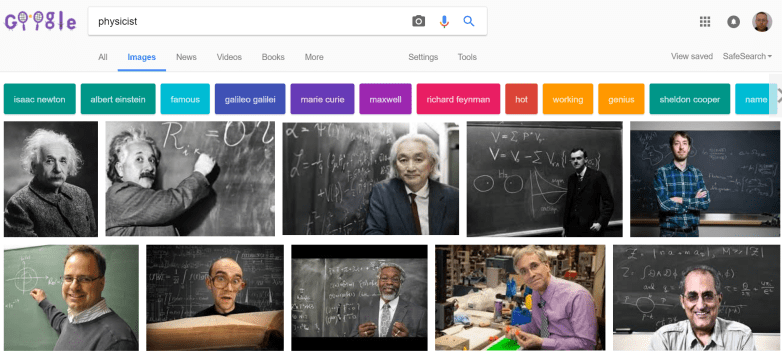 I am tweaking (someone else’s set of) slides for a schools careers talk. Tomorrow Farnborough College have a careers day, and it is my job to tell the students about what physics degrees and careers have to offer. Most of the students will not have a scientist or engineer in the family, as I didn’t when I was their age. So they may have very little idea of what scientists and engineers do, or what careers science and engineering graduates do if they leave science and engineering on graduation, as many do. Tomorrow, I hope to demystify this, and help them make good decisions.
The fox knows many things, but the hedgehog knows one big thing
 The title is a (translated of course) quote from Archilochus, a Greek poet from the 7th century BC. Somewhat randomly, this quote from a long dead Greek poet is very popular in the fields of data science and prediction. Nate Silver’s fivethirtyeight.com site has a stylised fox as logo in reference to this quote, although I don’t think he was the first to start using it. The quote is used to classify people, in particular those making predictions, into two groups: the hedgehogs and the foxes.
Beautiful numbers
 A lot, maybe most, of the fun behaviour that occurs in physics is controlled by dimensionless numbers, i.e., quantities that don’t have units such as metres or seconds. These dimensionless numbers are typically ratios between two quantities. Each of the two quantities has the same dimensions (units) and so these units cancel, making the ratio dimensionless. There are many of them in physics, but perhaps the only one in common use is the Mach number — named after the German physicist Ernst Mach. The Mach number is the ratio between two speeds, the speed of an object, often an aircraft as above, and the speed of sound. When the Mach number is greater than one, the plane is supersonic, and when it is less than one the plane is subsonic.
Evaporation, Pierre-Simon Laplace and crispy potato wedges
 I am on record as saying that evaporation is one of the big challenges in physics. As further evidence to support this, I give you the potato wedge. Note that the potato wedges shown above are crispy and burnt along their top edges. This blog post is about why this is.
The Marangoni effect
Liquids form approximately spherical droplets because of surface tension. Surface tension is a force acting at the surfaces of liquids that tends to contract the area of these surfaces, and a sphere has the minimum surface area for a given volume. This is cute. But even cuter is that any time the surface tension of a liquid is not the same everywhere ,then the areas of the surface at lower surface tension tend to expand while those areas at higher surface tension contract – this is called the Marangoni effect and is illustrated in the YouTube clip above.
Learning from my old boss
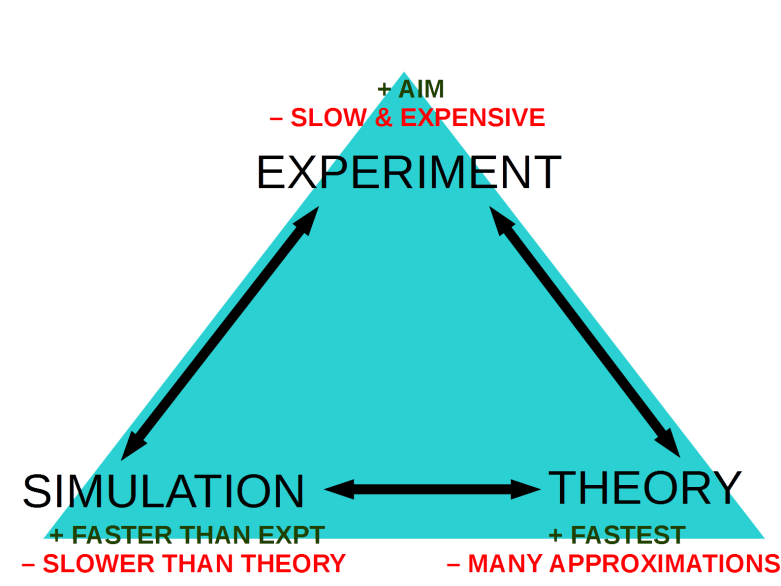 Twenty plus years I ago I was a fresh-faced PhD student, and my then PhD supervisor, George Jackson was selling the science his group, including me, did. I remember that he was a fan of triangles like the one shown above. His group was doing both computer simulations and theory at the time, and he wanted to make the point that they complement each other, and help to understand and predict experiment.
Evaporation!
A few weeks ago, our new boss, Vice Chancellor Professor Max Lu, visited the physics department. He started last year and is touring the departments in his new domain. I think it went well, it was good to both tell him what we do, and listen to what he had to say. In a UK academic environment that often looks dominated by league tables and competition, it was good to hear him stress the importance of our teaching students great stuff, stuff that they will use and that will make them better people.
More and less snow on the roof of Europe
.jpg) Earlier this week I was at scientific meeting on how water freezes, a key problem in understanding how the cold clouds and snow form. The very last talk I caught before I had to leave to catch my train, showed some striking data. We know that ice and snow in the atmosphere almost always start to form not just from water on its own, but from water in contact with a tiny particle in the atmosphere. So the number of these particles and their surface properties greatly influence how clouds and snow form. If, for whatever reason, there are many of these particles in the air, we may get more snow.
Earlier this week I was at scientific meeting on how water freezes, a key problem in understanding how the cold clouds and snow form. The very last talk I caught before I had to leave to catch my train, showed some striking data. We know that ice and snow in the atmosphere almost always start to form not just from water on its own, but from water in contact with a tiny particle in the atmosphere. So the number of these particles and their surface properties greatly influence how clouds and snow form. If, for whatever reason, there are many of these particles in the air, we may get more snow.
 Chance & Necessity