Just before lockdown I had a new kitchen installed, complete with a new oven and stovetop. A friend has also just had a new kitchen installed. Both lovely kitchens but I have a stove with traditional gas burners, while he went for induction hobs. To be honest I didn’t think about this much, my old stove had gas burners so I got new ones.
Both gas and induction hobs do the same job and both typically have a maximum power consumption of around 2 kW. To put this is context, an adult just pottering around (i.e., not running or otherwise engaging in a lot of physical activity), has a power consumption of around 100 W. So a hob going full blast consumes twenty times the power of human being at rest, and so puts out twenty times the heat, which to you need to, to cook the food.
For an induction hob that is the end of the story, it just converts electricity to heat. Gas hobs of course burn (methane) gas and so generate heat in basically the same way our bodies do. Both gas hobs and our bodies burn chemical fuel by combining it with oxygen, and produce not only heat but also CO2 and water. The methane that gas hobs use is essentially a carbohydrate, albeit a very small one, which is why it is a gas. And we of course burn (amongst other things) carbohydrates to keep us going.
The fact that that chemistry is similar but the power output is twenty times higher, means that a gas burner at full blast produces about twenty times as much as CO2 as a human. Having a single hob on full blast is like having twenty extra people in the kitchen, in terms of O2 consumption and CO2 production! This is a lot of CO2.
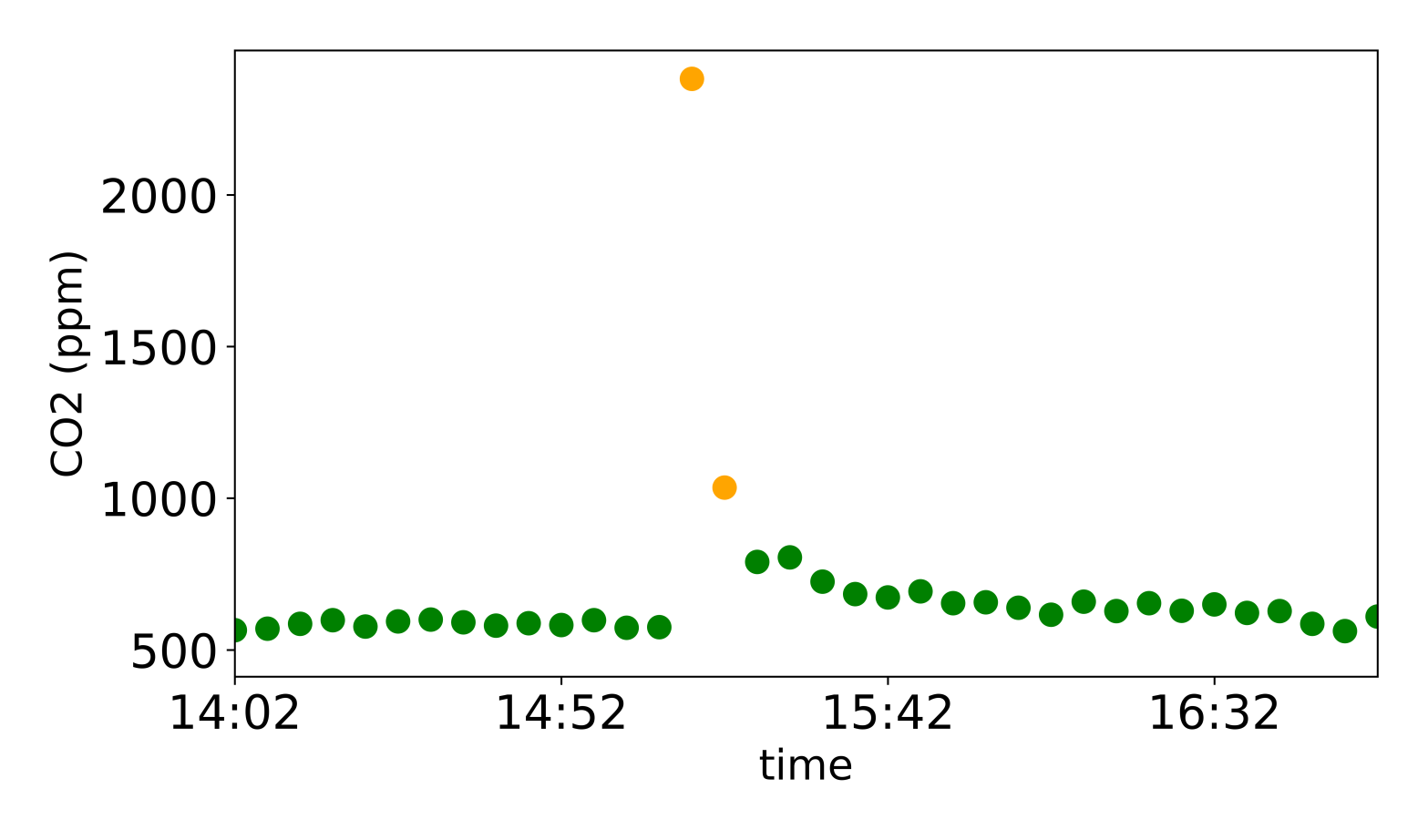
See above for a plot from my CO2 meter in my kichen. On Sunday I had left the CO2 monitor on a shelf just above the stove while I was warming some frozen peas as part of a late lunch. The CO2 spiked (two orange circles), but when I saw that, I moved it to another place in the kitchen, and the CO2 level dropped. So the two orange points are when the CO2 monitor was above a single gas burner.
Once I had moved the monitor, it measured the CO2 in my kitchen, which had a window open, and was open to the living room. As the kitchen was reasonably well ventilated, the region of very high CO2 was probably quite small. CO2 is not a poison so there is no strict limit on its concentration, but keeping it below 1000 ppm (parts per million) is the usual guideline.
To do this you really need to cook with windows open (and/or an extractor fan going). My kitchen is small, say 10 m3. A human doing some cooking breathes out maybe 0.2 m3 of CO2 in an hour. Diluted in 10 m3, this is 20,000 ppm. So if there is zero ventilation, even after an hour’s salad preparation, a small kitchen’s air will be bad. Add in two gas hobs each at half power and it will be closer to 400,000 ppm, which looks dangerous.
So, I think the lesson is, always cook with a window open! And that induction hobs have at least one advantage over gas burners. It is not all good news for induction hobs. Induction hobs are currently more expensive to cook with than gas burners – current energy caps are £0.30 per kWh for electricity and £0.08 per kWh for gas, and both induction and gas hobs should be very efficient as they are just converting energy to heat. But as we continue to run out of gas and transition to lower-carbon forms of energy, I guess this will change.


