 Above is an image taken from a BBC webpage What is diffusion? – part of their Bitesize website, and aimed at 11 to 14 year olds*. So if you are from the BBC and you don’t like me using it, then just let me know and I will take it down, but the image on that page is fundamentally misleading, as I will explain. So arguably it should not appear on the BBC’s website either.
Category Archives: Science
Politely disagreeing with the BBC and a teacher
 I am currently teaching biological physics to third-year physics undergraduates. As part of this I teach about how living organisms acquire food molecules, oxygen etc, and how large living organisms, such as ourselves, transport these food molecules, oxygen, etc around our bodies. A fundamental point that I make, is that diffusion is only fast enough to support the demands of life when the movement is over very small distances, around 1 mm or less. Over distances more than very roughly 1 mm, some sort of flow is required to move molecules around. Over distances of centimetres, metres and above, diffusion is very very slow.
Teaching data fitting better
One of the most useful skills we teach on the physics degree is data analysis. This is important in almost all scientific research, and it is also key to good decision making in other fields such as economics, as well as being a core part of data science — increasing numbers of our graduates are going into the growing number of careers as data scientists. One basic task in data analysis is fitting a model to noisy data, eg fitting a straight line y = mx + c to data of the form a set of points (x , y). As far as I know there is essentially complete consensus about how to determine the best values of the two fit parameters, the intercept c and the slope m. This is to minimise the sum of the squared differences between the fit function, and the data points.
From crisps to £800 skin cream
 I have just gotten back from the 3rd Sir Sam Edwards – New Horizons in Soft matter meeting. The meeting has an emphasis on bringing together soft matter scientists from universities and companies. As a university-based scientist it is fascinating to hear of the soft matter challenges companies face.
These vary from turning tons of potatoes into crisps, to making cosmetics that are sold for silly money.
There is a lot physicists don’t know about living cells, but we do know some things, such as you don’t have hot mitochondria
 Last year, Chrétien et al. published a paper in PLOS Biology on mitochondria. Two mitochondria are shown above, they are structures inside our cells where a key part of our energy metabolism take place. I don’t want to be harsh, but the central claim of their work is clearly wrong. This claim is that the mitochondria inside cells are at a temperature of around 50 C, more than 10 C higher than the rest of the cell which is about 37 C. This really cannot be right, the mitochondria inside your body are at the same 37 C that the rest of you is, and with a little physics it is easy to see why.
Dissolving in a hurry
We have all added salt or sugar to water and seen it dissolve. Both salt and sugar dissolve rapidly, but exactly how fast do they dissolve? This is one of those seemingly innocent questions, that is a lot harder to answer than you might expect, or hope. For something highly soluble like salt we expect the sodium and chloride ions at the surface of the dissolving salt crystal, to very rapidly move into solution in the surrounding water. But if the water is stationary, not stirred, then near the surface of the salt crystal, we quickly reach the point where the water is saturated with salt, and no more can dissolve, until the sodium and chloride ions move away.
Attendance predicts attainment, so we need to encourage attendance
There is a pretty big push at the University of Surrey to record lectures, so students can view them at another time. I think recording lectures is popular among many students, and I plan to do it for one of my courses next year. But another question is: Does it help students learn more? A recent study by Edwards and Clinton suggests that it does not.
Membrane proteins and the Curse of Dimensionality

I am at a conference in Sorrento, Italy. My hotel room is described as having a ‘hill view’, and as you can see from this picture taken from my hotel room, the description is accurate. That is a genuine Italian hill. In Sorrento, I will be talking about my work on paint drying, but I have a bit of time before the conference sessions start. So, I am also working on a course I am teaching next month for the EU network on RAtionalising Membrane Protein crystallisation (RAMP).
How lucky are you feeling?
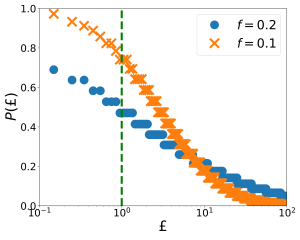 I am rewriting a computational modelling project on modelling the stock market, so I am doing a bit of background reading. Fortune’s Formula by William Poundstone is a good general-interest description of some work from the 1950s onwards, on developing models for both the stockmarket, and gambling in casinos. In terms of mathematical modelling, gambling (aka investing) in the stock market, and gambling in casinos are almost the same — the aim is the same in both: maximise the money acquired while minimise the risk.
Redistribution in UK universities, from wealthy overseas parents to the British taxpayer and to charities
Universities that do research as well as teach, like Surrey, are funded from many different sources, and their finances are complex. But roughly two-thirds of the money the Department has to pay my salary comes from student fees and government funding for teaching, leaving one-third of my salary to be paid for from research income. The distribution of my time between teaching and research is maybe half-and-half*. Teaching is subsidising research, in the sense that student fees are paying my salary for some time when I am doing research.
 Chance & Necessity