Carbon dioxide levels in your home & you

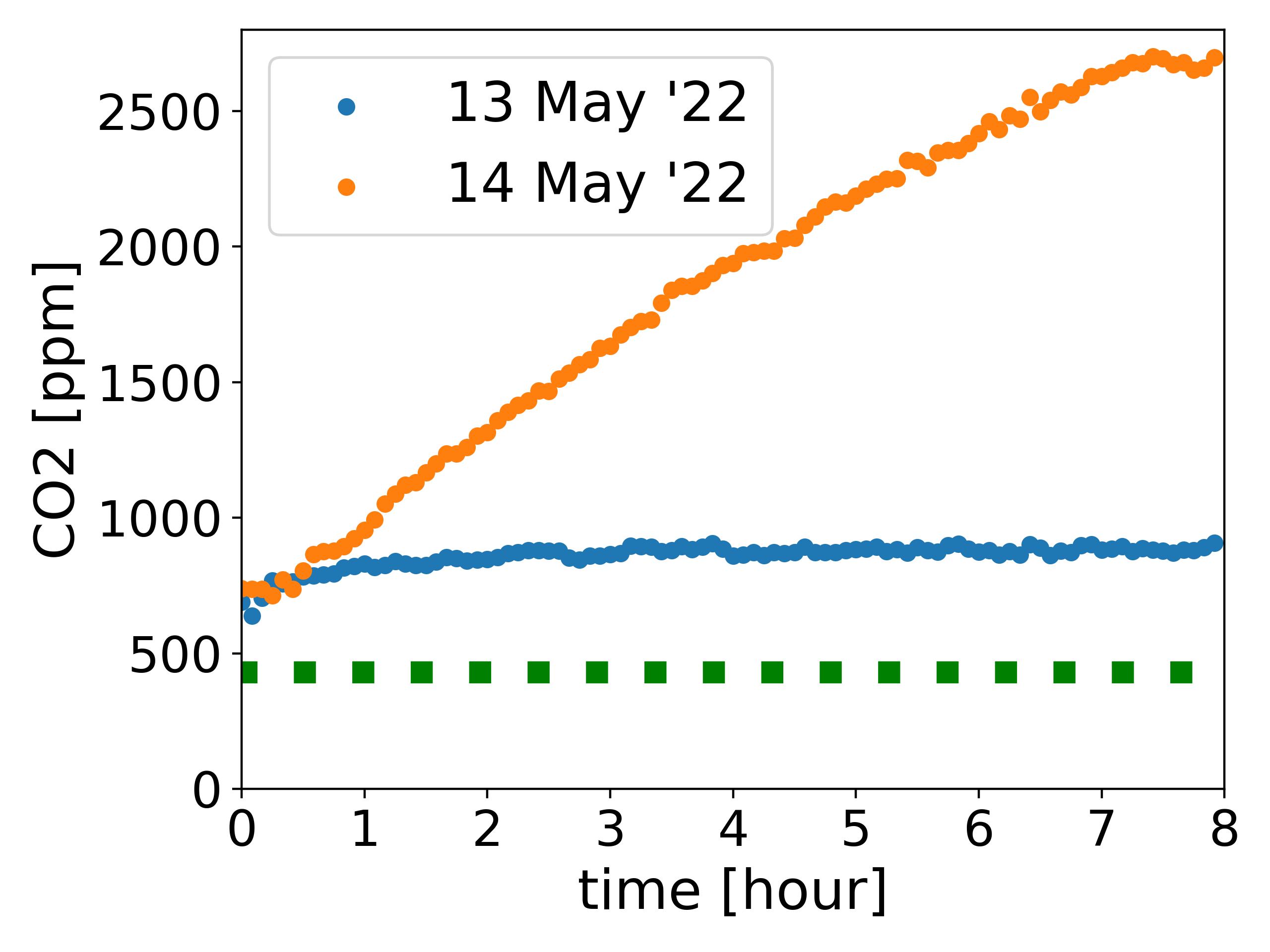
Teaching is now almost finished for this academic year. On Friday I had my last meeting with one of my project students. It was nice, he has learnt a lot and we said we’d next meeting at graduation in July. So I have a bit more time, and a new toy: a CO2 meter*. This measures the carbon dioxide aka CO2 in the air. The concentration of CO2 in the Earth’s atmosphere is about 400 ppm** – where ppm = parts per million. Out of every million molecules in the atmosphere, 400 are CO2. There is some evidence – although I am not sure it is very strong – that at CO2 levels above 1000 ppm your brain functions a little less well. In any event, CO2 levels allow you to estimate how well ventilated a room is.

More

Is it best to sleep with a window open at least a little?

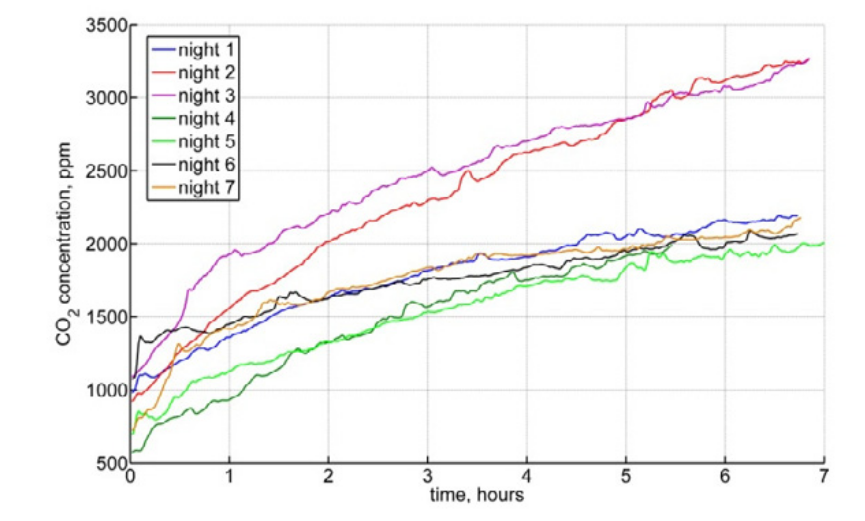
Figure 10 from Batog and Badura 2013, Procedia Engineering 57, 175. One person sleeping in a bedroom with air volume 21 m3, with bedroom window and door closed.

Above is a plot of the concentration of carbon dioxide (C02) in a bedroom in which one person is getting about 6.5 to 7 hours of sleep. Plot is as a function of time from when they go to bed to when they get out of bed, and is from a 2013 paper by Batog and Badura. The units are parts per million (ppm). For context, the atmospheric CO2 concentration is about 400 ppm, i.e., in the Earth’s atmosphere (i.e., outside our homes) out of every 1 million molecules, 400 are carbon dioxide*. In our homes and offices, the CO2 concentration is higher because we are all breathing out CO2. We breathe in oxygen (O2), use it to burn our food for energy, then breathe out the CO2 this produces. As far as I know, there are basically no set limits on CO2 concentrations but guidance for workplaces, schools, etc is typically that it should be no more than a 1000 ppm. As you can see, this concentration is exceeded for most of the night.

More

How likely are you to get COVID in a sauna?

We don’t know the answer to this question. Over the two years of the pandemic there has been a fair amount of debate on how far COVID-19 can spread, with some people, incorrectly, thinking that it rarely travels more than a metre or two across a room. But we have clear examples, such as in a restaurant in Guangzhou, where COVID-19 spread across a room. So, I hope this debate is settled, you can catch COVID-19, and almost certainly, flu, from across a room. We also know that masks offer some protection, with FFP2/N95 masks offering much more protection than cloth masks.

More

Beards and mask wearing: Dos and don’ts

From American CDC guidance on wearing masks/respirators

Back in the carefree year 2017, the USA Centers for Disease Control (CDC) produced the above guidance for healthcare workers who needed to wear masks for work, but favoured facial hear. It was motivated by Movember. The green ticks mean that the style of facial hair is compatible with wearing a fit-tested mask, the red crosses indicates that the style is not allowed, and those healthcare workers who need to mask-up at work will need to get the razor out. Most moustaches are allowed but almost all beards are banned as there is then facial hair where the mask has to fit tightly to the skin (see top left of image) to get a good seal and prevent air leaking around the edges.

More

If you know what you are doing you get the same result from a 1940s differential analyser and a modern computer running Python

Above is an aircraft wing which has picked up ice on the leading edge of its wing. This is of course is not ideal, especially for an aircraft in the air. You don’t want large amounts of ice forming along the leading edge of the wing in flight, it will add weight and make the wing less able to generate lift. I think there were particular worries about this during the Second World War, possibly because planes were flying higher and faster as the war drove rapid advances in aircraft design and performance. So the United States Army Air Force turned to the dream team of a Nobel-prize winner, Irving Langmuir, and the first woman to obtain a PhD in physics from the University of Cambridge, Katherine Blodgett. They worked to understand the following problem.

More

How virus-containing droplets are made

CSIRO ScienceImage 6552 Dripping tap Perth WA 1975

Transmission of COVID-19 likely starts with production of a small droplet that contains one or more SARS-CoV-2 viruses. This occurs somewhere in the lungs, throat, or mouth of an infected person. We have almost no data on this process as it occurs inside the body of an infected person, but we do know how droplets are generally made. One mechanism is named after Lord Rayleigh and Joseph Plateau, and we have all seen it in action. We see it every time we turn a tap a little bit on, and it drips. The stream of water from the tap breaks up into droplets, and the same thing may be happening inside us every time we breath.

More

No such thing as an average infected person

I am very struck by this quote from a paper measuring the concentration of corona virus (aka SARS-CoV-2) in swabs taken from infected people

Initial SARS-CoV-2 viral load is widely distributed ranging from 3 to 10 log copies/ml …

Jacot et al, medRxiv 2020

Note the log in the first sentence, the range is not from 3 to 10 — about a factor of 3 — it is from 103 to 1010 viruses per millilitre — a range where the top end is 10 million times the bottom end. In other words, some people at some times during their COVID-19 infection have ten million times as much virus as others do. On a log scale, the average is 106.5 ~ 3 million viruses per millilitre but some infected people have thousands of times more, while others have thousands of times less.

More

Minimal model of corona virus exposure

Transmission of the corona virus (aka SARS-CoV-2) is very complex, which is basically why it is so poorly understood. But in true theoretical-physicist style, a minimal model has been developed, by a guy called Roland Netz (who is a theoretical physicist in Berlin). It makes a lot of assumptions, and it is clear that there is lot of variability, between one infected individual and another and between one situation and another, so its predictions should be taken with a large pinch of salt. But in this post I will outline this minimal model.

More

A-level grades, degree classifications and calling bullshit

Today I am reading both Calling Bullshit by Jevin West and Carl Bergstrom, and of a “growing crisis” over Scottish Higher results — presumably a similar crisis will happen for A levels when the results are released in a few days. I have got to the bit in Calling Bullshit where West and Bergstrom talk about bullshitting via statements that superficially look rigorous, but in reality are pretty flaky. In this blog post I want to suggest, possibly controversially, that the distinctions at the root of the growing crisis in Scotland, between a grade A and B in a Scottish Higher*, or a B and C, etc, have a slight whiff of bullshit about them.

More

No more than the weight of a cherry

Colleagues at the University of Bristol and I are working on trying to understand how masks work. One fundamental aspect of this is that a mask, like any filter, fundamentally involves a trade off. A mask must as permeable as possible to air, but as impermeable as possible to virus-containing droplets. Air must flow through a mask as freely as possible, but droplets should find the mask as close to impenetrable as possible. The problems is that these two design constraints directly contradict each other, and so any mask, any filter in fact, is a compromise.

More