Don’t get too excited

YD LawWhat with high pressure penalties, last minute corners, etc, now is a good time to consider the Yerkes-Dodson Law. This is illustrated in the figure to the left. Basically it shows how difficult you find doing a task, e.g., taking a good penalty, is as a function of how much stress you are under/how much adrenalin is in your bloodstream. The y-axis says learning but is known to be more general than just learning.

For simple tasks (solid curve), the more adrenalin, the better, i.e., the more likely it is that you complete the simple task correctly. But for tasks where you have to think (see the dashed curve), it is not so simple. A bit of stress, a bit of adrenalin, helps, but too much hinders you, and the chance of you failing goes back up. There is an optimal level of pressure where you perform your best. Being half asleep is bad, but so is being panicked.
More

The Department where CDs never go out of fashion

CD autolev cropToday was the second of two back-to-back Open Days the University runs for prospective students. A-level students thinking of going to university in autumn 2015, and their parents, visit the university to learn about degrees and university life. Today we had about 350 to 400 visitors in the Department, and maybe a bit more than half than yesterday.

More

Direct from the Sun

20140621_221128

As a scientist I guess I should stop and admire the beautiful natural world a bit more than I do. Too busy doing stuff most of the time, which is a poor excuse. Anyway, above is a picture of sunset over the river Seine in Paris. To the right you can see twin squarish towers, this is I think the Notre Dame cathedral.

More

Starve yourself, drink plenty of red wine, take statins, and listen to music, and you’ll never have a cold ever again!

A couple of weeks ago The Telegraph reported that: “Fasting for three days can regenerate entire immune system, study finds“. This sounds a bit like hard work to me, I have to say. I like food. Maybe you agree, if so we are in luck. Because, also according to the Telegraph: “Daily glass of wine boosts the immune system“. I have to say that that sounds a lot more like it to me. But what if you don’t like wine? Well, you are still in luck, because you can try taking statins: “Statins ‘could boost immune system’“. Don’t like drugs? No problem: “Music can boost your immune system“.

More

Believe first, ask questions later

Naively, you might think then when presented with a statement that is new to us, we start out not believing it, and then decide if we believe it or not. But apparently, it is the other way around. We have an inbuilt tendency to believe everything we are told, and only then afterwards do we check to see if it is true.

More

Is competition the answer?

Academia has always been pretty competitive. It took me about 2 years of looking to get a job as a academic, including a somewhat bruising  and unsuccessful interview at Imperial (the question “Do you consider yourself a loner?” did rather throw me). And if anything 2 years is shorter than average. If you apply for a job as an academic you should accept that maybe 30 to 100 others will be applying for the same job, including some smart, hard working and ambitious people. But despite the pressure and work load, being an academic is still a good job, with a lot more freedom than most other jobs. And, as I tell my tutees “Good jobs are hard to get as the competition is strong, so you need to work on getting a good CV”, so you should expect getting a job as an academic to be competitive.

More

All models are wrong, unless you have limited data, in which case most models are right

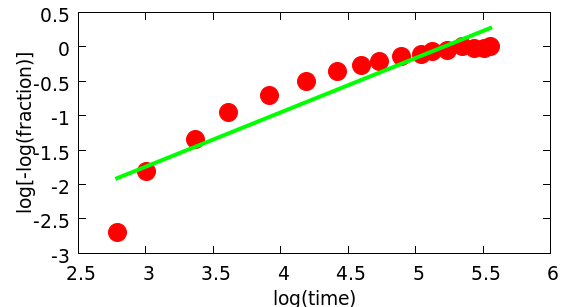
I am very fond of the quote by the statistician George Box: “essentially, all models are wrong, but some are useful”. It is true, all our models are wrong if you look carefully enough. For example, Newton’s model of gravity is pretty good for calculating our orbit around the Sun, but if you look carefully enough you will see it is wrong. Careful measurements and general relativity have told us that it is an approximation. The same thing applies to pretty much every model we have.

More

Paper after paper rejected, yet no front page story for me

Yesterday The Times led with a story that a paper on climate science was rejected by the journal Environmental Research Letters. Sorry, it is behind a paywall so you will have to take my word for it. But the Telegraph and Mail both have articles on it, both of which manage to imply ‘McCarthy’ style persecution of Prof Benngtsson, one of the authors of the paper. I have had many papers rejected from a number of journals. Also as a peer-reviewer I have recommended the rejection of more papers than I care to remember. I am upset. Despite my heroic efforts none of the Times, Mail or Telegraph have ever run articles either lamenting my fate at the hands of McCarthyite persecutors, or when I was the reviewer, making me feel important by claiming that I am part of such a conspiracy.

More