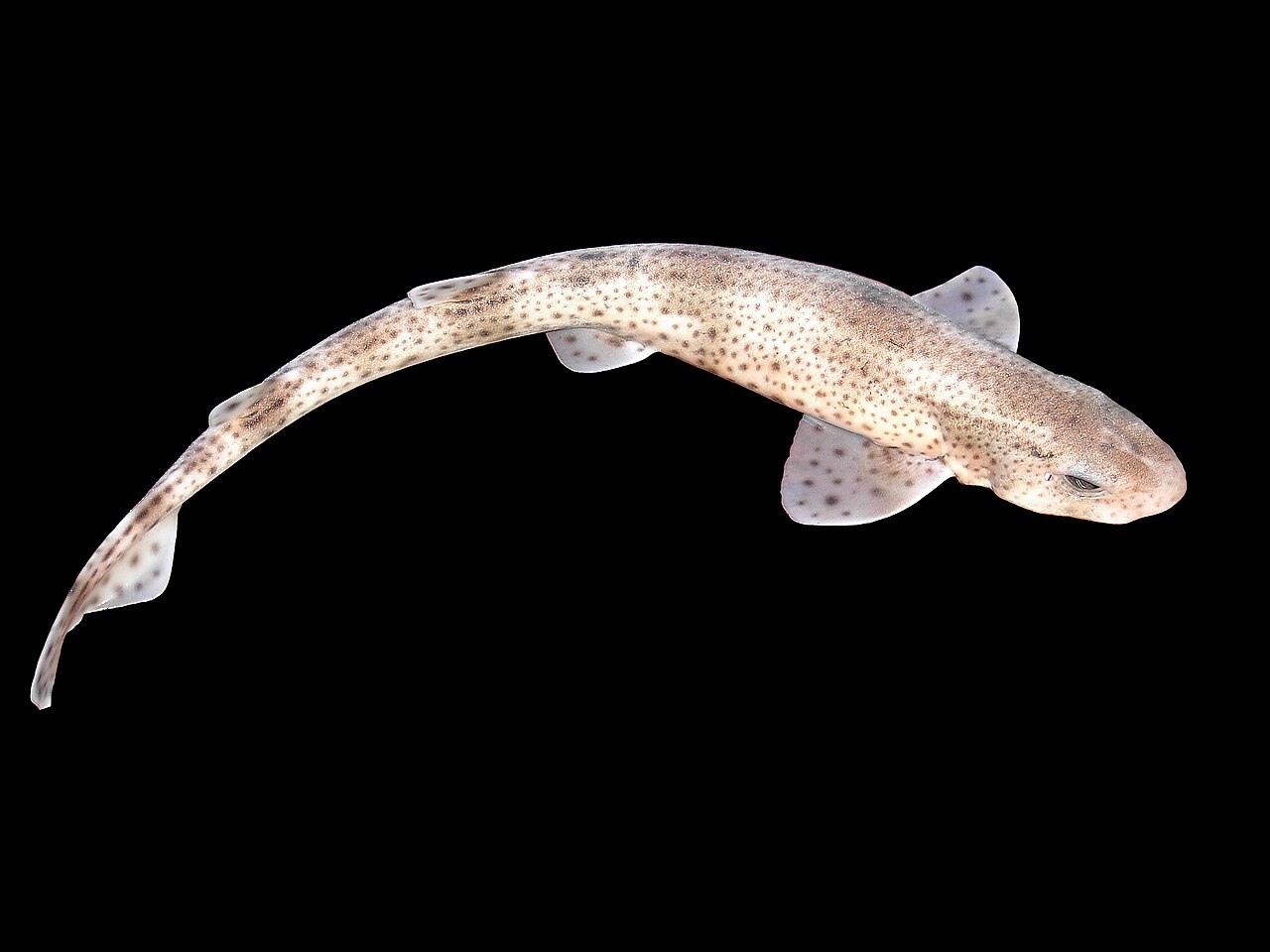
This beautiful image is of the small-spotted catshark, and is by Hans Hillewaert (Wikimedia). They are carnivores and hunt on the seabed, where I think vision is poor. So they have evolved to hunt, in part, by sensing the electric fields due to their prey. This was shown over 50 years ago, with some beautiful work by AJ Kalmijn. There is a lovely Scientific American article on this, by RD Fields, in 2007.
I think the point is that the metabolism of a fish or crab or …, has as a byproduct a lot of pumping of ions around, eg through the fish’s gills. Both the cells of fish and our cells are constantly pumping sodium, potassium, chloride etc ions in and out of the cell. These cellular pumps maintain the environment inside the cell – which is very different both from that of sea water and from that inside the fluids of both our bodies and fish. Our blood tastes salty because it is salty. It contains a lot of sodium chloride. But our cells have more potassium than sodium inside them.
This pumping of the (charged) ions sets up a weak current in the sea water* surrounding the fish. This current can be measured and I have seen values of around 10 µA. The resistivity of the sea water is around 0.1 Ω/m, and so this current implies a voltage of 0.1 µV, which for an 10 cm long fish gives an electric field nearby of perhaps 1 µV/m.
This electric field looks small, and it is. But catfish are hungry, and evolution is powerful. If a flounder is hiding in sand or mud then it is invisible (so vision is useless), and if it is just resting (so no motion or sound to detect) then it may be emitting few molecules (so smell is useless). Then the electric field may be the only sign that the flounder is there. So the catfish has evolved to sense these electric fields, from its prey.
So how does the catfish detect these tiny electric fields in the sea water it swims through? This has been tracked down to its Ampullae of Lorenzini. These are pores in the nose of the fish that lead to internal, highly conductive, bulbs that do the sensing. How do the Ampullae of Lorenzini work? I am not sure.
I also don’t have a good feel for what sets the scale of the voltage at µA, or a potential drop of µV? Why µA, not nA or mA? I don’t know. I am not sure if it is even known why. So a remarkable example of the power of evolution, but a lot of questions about the details of how the fields are generated and sensed by the fish.
* Sea water is a much better conductor of electricity that air is, so I don’t think our metabolism creates much of an electric field in the air surrounding us.

 Chance & Necessity
