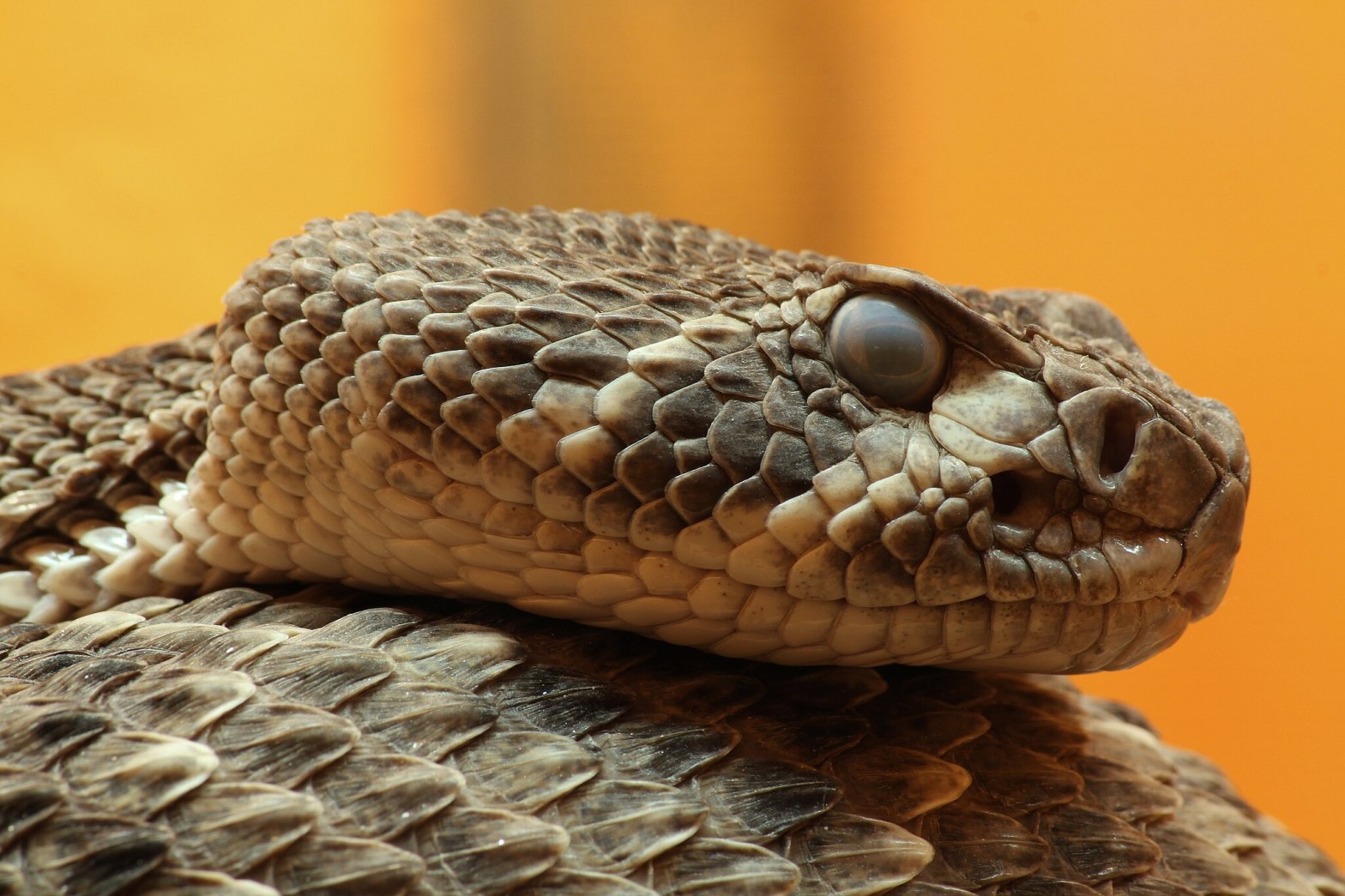
This* is the head of a western diamond rattlesnake, a species of pit viper that is common in the USA and Mexico. Pit vipers are a family of species of snakes that called pit vipers because they have a specialised sensor organ – a pit – to detect thermal radiation (ak infrared or IR radiation). This in addition of course to their eyes which detect visible radiation. If you look carefully you can see a pit in the picture above. From left to right it lies about halfway across between the eye and the nostril, and it is close to the bottom of the head. It is hard to see because it is a pit so you really just see the shadow.
I am no snake expert but I think the idea is that pit vipers hunt warm-blooded prey (eg smallish mammals like mice) at night. Then there is no light to see by but their prey are warmer than the surroundings, and so the prey give off more heat, more thermal radiation.
Detecting thermal radiation is fundamentally a lot tougher than detecting visible light. A photon of visible light has about 1 eV (10-19J) of energy, about 100 times larger than thermal energy. We (and snakes) see visible light via receptors (proteins) that absorb, and react to, single photons of visible light. The photon has enough energy to flip the shape of the receptor protein.
However photons of thermal energy are much weaker. Each photon of thermal energy has an energy of around the thermal energy (of order 10 meV = 10-21J) . As every molecule already has about this energy, the arrival of a single photon of thermal energy typically does not have much effect on a molecule.
Presumably because of the weakness of thermal energy photons, we believe that snakes detect thermal radiation in a fundamentally different to the way they, or we, see visible light.
We believe that snakes detect thermal radiation from the tiny heating affect it has on very thin specialised membranes inside their sensing pits. The classic work was done by Bullock and Diecke in 1956. Somewhat to my surprise, I am not sure it is been repeated into the subsequent 70 years.
Very roughly, I think the argument is as follows: an object (eg a mouse) a few cm across at say 300 K emits thermal energy at a rate of around 1 W. This emission is very sensitive to (absolute, i.e., in Kelvin) temperature so if the mouse is only 10 K hotter than its surroundings, it is maybe emitting 0.1 W excess thermal radiation. That excess thermal power is what the rattlesnake’s pit sensors detect.
Bullock and Diecke reckon that a nerve cell of the snake is hooked up to maybe an area of about 1000 μm2 in a membrane, and that the membrane is only 10 μm thick. Now an area 1000 μm2 half a metre away from the source picks up a fraction 10-8 of the 0.1 W excess thermal radiation. This factor just comes from the ratio of the area 1000 μm2 (=10-8m2), to the surface area of a sphere half a metre across (1 m2).
So the piece of membrane that can trigger a nerve cell is picking up 10-9W excess thermal power. Snakes detect pretty fast so may take 0.1 s to detect prey, so that is 10-10J. Cells are basically water which has a heat capacity of 106J/m3/K. So the volume of membrane is 104μm3, and has a heat capacity of 10-8J/K.
Then if all 10-10J is absorbed, that part of the membrane heats up by 0.01 K. In practice a fair amount of the radiation will go through the thin membrane, so maybe the temperature jump is 0.001 K or 1 mK.
It seems that the rattlesnake above can detect this tiny change in temperature. As they, like us, are at temperature of order 100 K, this is a fractional change in thermal energy of only 10-5! I am impressed that such a small change can be detected. I guess if you give evolution millions of years then it can come up with some impressively optimised systems.
* The, very impressive, picture is from Wikimedia and of a rattlesnake in a zoo, taken by Holger Crisp.

 Chance & Necessity
