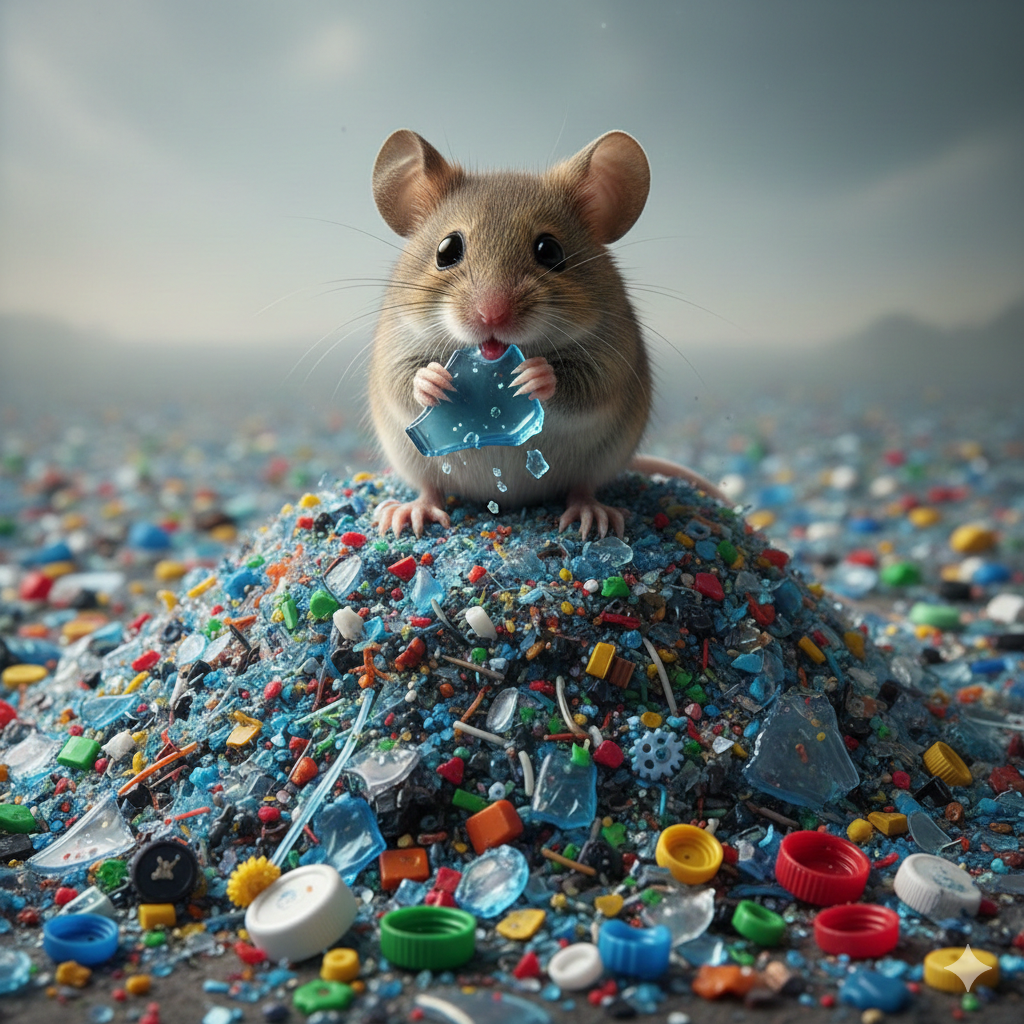
I quite like Wired magazine but it has run an article called: People Who Drink Bottled Water on a Daily Basis Ingest 90,000 More Microplastic Particles Each Year. I just cannot make sense of this. In particular I think the number 90,000 is supposed to be scarily big. But 90,000 particles of this size in one year is an absolutely tiny amount. Let me try and put the figure of 90,000 in context.
Let’s start with the number of particles in the air we breathe. The WHO recommend that the air we breathe contains around 1 μg/m3 or less of small particles, where here small means around a micrometre or less (called PM 2.5). 1 μg/m3 of 1 micrometre particles is about 1 million particles/m3. A 1-micrometre particle has a mass of around 1 pg. Over a year we inhale of order 1000 m3 of air, so if for the whole year we breathe in only WHO-approved air that is about a billion particles, or around 10,000 times this, supposedly scary, number of microplastic particles.
I would worry more us inhaling about billion particles of a diverse range of types, than drinking under a 100,000 particles of – typically quite inert – plastic particles. And this is if we breathe in WHO-approved air, many places do not have air of this quality. For example, New Delhi’s air can exceed WHO recommendations by a factor of 10 or 100, so that is 10 or a 100 billion particles inhaled per year.
London is much better but at the time of writing the PM 2.5 level* was 6 μg/m3 which is at the high end of what the WHO thinks we should accept. And that means London’s inhabitants are inhaling billions of particles a year, plus drinking in perhaps a 0.01% of that figure if they take lots of drinks from plastic bottles.
Now I have compared apples and oranges so far, particles taken in water with those inhaled. But water often has far higher concentrations of suspended particles than air.
For example take sea water, which may have 1 g/m3 of suspended particles – or more much in some cases. This a million times the concentration in air**. If only one part in a thousand of these particles are around 1 micrometre in size that is 1 mg/m3 of these particles which is around a billion of these particles per m3.
The Wired article cites a review by Sajedi, An and Chen. This cites studies that found concentrations of microplastic particles that are about around 1000 times less than in sea water, at around a million per m3. It is not clear to me that we should be losing sleep over concentrations of microplastics a 1000 times less than the particle concentration in sea water.
The review of Sajedi, An and Chen cited only a few studies on toxicity***, for example that of Lu and coworkers. Even if this study is correct, and even if its findings of effects of microplastics on mice**** transfer to us humans, then Lu and coworkers use concentrations of 1 g/m3. For 1 micrometre particles this is a concentration of a trillion (1,000,000,000,000) per m3. This is a million times more than found in bottled water.
Even if you believe you can extrapolate from mice to humans, this factor of a million in dose is a lot. I have just consumed one beer and feel fine, a million beers would be a different story.
* From IQAir, PM 2.5 is the mass of aerosol (ie suspended in air) particles with diameters 2.5 μm or smaller.
** On a per unit volume, water typically has a lot more in it than air, but we take in a lot more air than water as we breathe much larger volumes than we eat/drink.
*** And these small number of studies are not in the best journals, which is a bit of an amber flag if not an outright red flag.
*** The featured image is from Google Gemini’s Nano Banana.

 Chance & Necessity