Most papers published in the fancy journals Nature or Science are not much different from papers in regular journals, but a few have real impact. One of these is a pioneering paper by Deegan and coworkers published in Nature in 1997 (pdf here). It has been cited almost 6000 times, which by coincidence is close to the total number of citations of everything I have published in a thirty-year scientific career. Bit of a shame I did not discover something that good in my PhD, I could have taken the other twenty-plus years off.
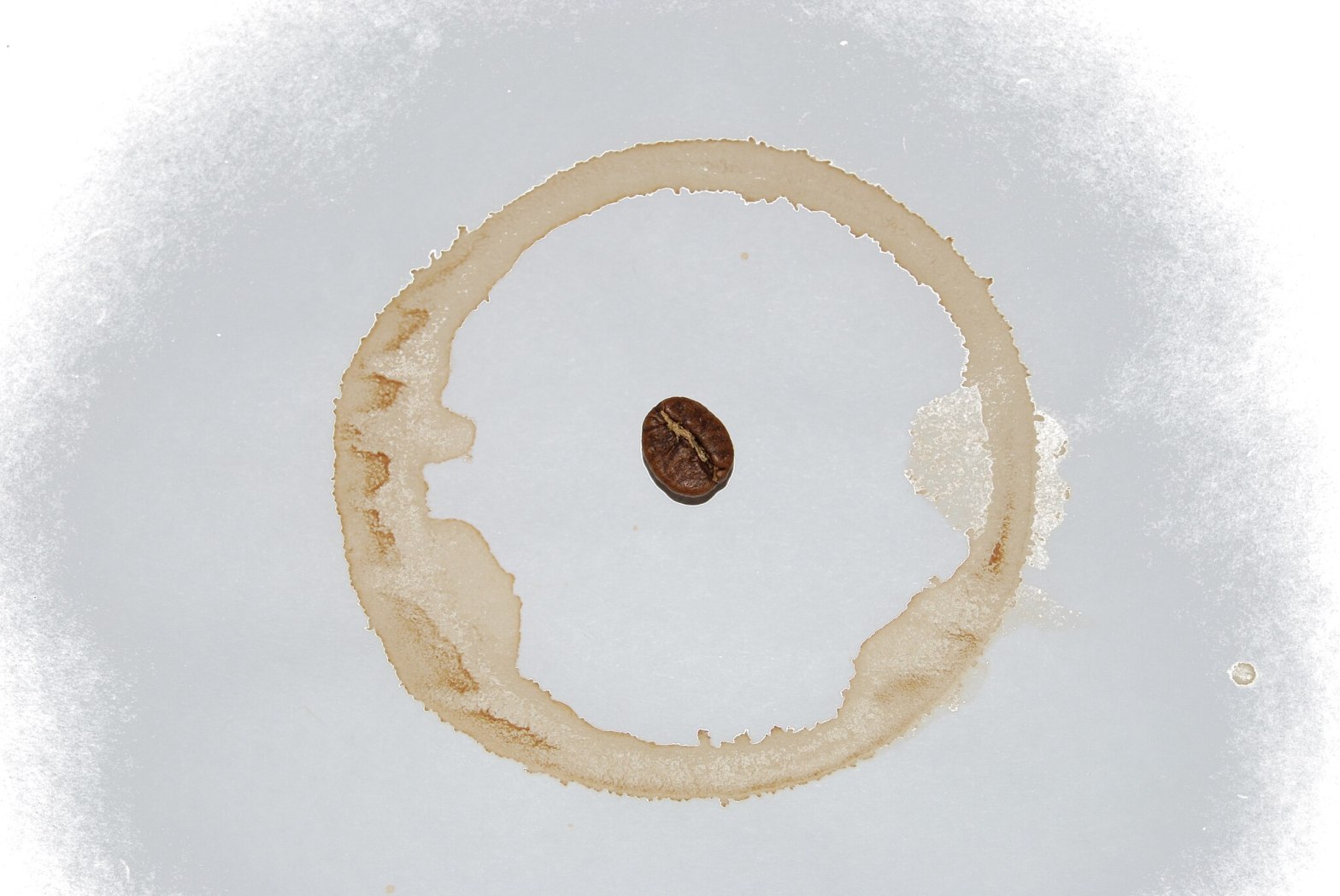
The paper of Deegan and coworkers is on the “coffee-ring effect”. This effect is illustrated above, with a coffee bean in the centre to show the scale. The very pretty image is by Matt Davis. The coffee-ring effect is a phenomenon that occurs when a particle-laden liquid droplet evaporates, leaving behind a ring-shaped deposit of particles. The name comes from the fact that this effect is commonly seen when droplets of coffee dry on a surface. However, it can also be seen with other liquids, such as red wine, ink, and paint.*
As you can see above, the particles – here coffee grounds – left when a drop evaporates, form a ring. The ring outlines where the edge of the original drop was, when the water started to evaporate. The point being that these grounds were roughly uniformly distributed in the wet coffee drop but as it dried almost all the grounds moved to the edge of the drying droplet. Note that typically the edge of the drop is stuck in place, i.e., it does not move during drying; drying just occurs by the droplet becoming flatter and flatter at constant radius until all the water is gone.
I think Deegan and coworkers were the first to explain why the ring forms. There are a lot of complex details (many of these worked out in the 6000 citing papers!) but the basics are as follows: During drying the water evaporates of course. But it does not do this uniformly, drying is very fast at the edges and much slower near the centre. The maths here is a little complex but if you do the maths for water diffusing away from the droplet in the surrounding air, you get an evaporation rate J that varies roughly as J ~ 1 / ( R – r )-1/2, with R the radius of the droplet and r the distance from the centre of the drying droplet**. The evaporation rate is slowest at the centre of the droplet, and as the edge of the droplet (where r = R) is approached, the evaporation rate diverges.
This very fast evaporation at the drop’s edges pulls water from the centre to the edges, the velocity of flowing water in the drying droplet also looks very roughly like 1 / ( R – r )-1/2. It is this flow of water towards the edges, to balance the fast evaporation there, that carries the coffee grounds towards the edge. Then when the grounds reach the edge they just pile up forming a ring, left behind by the evaporating water.
This is the basics of the coffee-ring. So what has this to do with viruses?
One route of virus transmission is via what are called fomites. The fomite route is basically when an infected person breathes out a droplet containing a virus or bacterium, and this droplet falls onto a surface. Then later someone picks it from the surface, puts it into their mouth and becomes infected. For COVID-19 and flu, the fomite route may be rare or very rare, as most/almost all are infected by inhaling the virus directly. But we can still consider the fomite route.
If the droplet dries in the air before it hits the surface, we won’t get a coffee-ring effect — the coffee-ring effect only occurs for drying on surfaces. But if the droplet is still wet when it hits the surface, we may well get a coffee-ring effect***.
And this looks bad news for viruses. Viruses are delicate. Being pulled on by water as it flows towards the edges does not have to be bad for viruses except that near the droplet edges the droplet is thin. This means the the fluid velocity varies steeply from zero in the water immediately in contact with the surface to a speed scaling roughly as 1 / ( R – r )-1/2, over the height of the droplet. If near the edge of the droplet, the height of the droplet varies linearly then height will scaling roughly as R – r.
Then the shearing of the fluid, effectively how rapidly the flow velocity varies with height, will scale as 1 / ( R – r )-3/2, a pretty steep divergence as the edge of the droplet is approached. Fluids have a property called viscosity which opposes – with forces – shearing. Shearing forces are bad for viruses, they can tear viruses apart.
Formally the power law shearing forces diverges at the droplet edge, and infinite forces of course destroy everything including viruses. In practice, this divergence will be cut off. But the most obvious scale to cut them off involves water’s surface tension and a lengthscale L, this combination of surface tension and a length gives a shear stress of around 0.1/L Pa for L in metres. This stress looks large enough to destroy viruses, essentially because the forces that hold the viral envelope together have essentially the same strength as those that hold liquid water together (i.e., water’s surface tension).
So, if a droplet containing say a flu virus is still wet when it hits a surface, and if mucus allows the coffee-ring effect, then this could easily destroy many viruses. So maybe the coffee-ring effect is playing a role in making fomite transmission a rare way to get flu or COVID-19?
* These three sentences are from Google Bard’s answer to my question: What is the coffee-ring effect? This bit is right and I think quite clear so I used it. Most of the rest of Bard’s quite long answer is garbage.
** It is a bit more comples than this, the exponent is not precisely a constant or one half, but this will do for a blog post.
*** Or we may not, the droplets are of mucus which is complex mixture of salt, proteins and fats, which will almost certainly affect the coffee-ring effect, and may even effectively eliminate it.

 Chance & Necessity
.jpg)