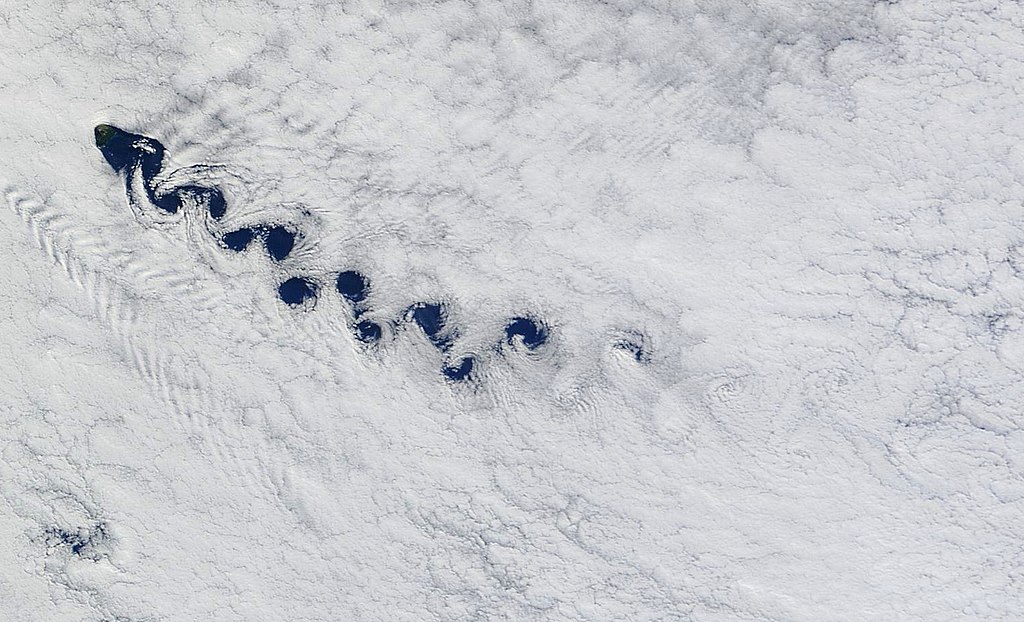
Theodore von Karman was a Hungarian-American fluid mechanics scientist/engineer active from early to the middle of the twentieth century. He was very smart and pioneered understanding the fluid flows needed for jet-powered flight. He was also the first to develop a theory for what are called von Karman streets. These can be rather beautiful, an example is shown above, in an image from a NASA satellite. At the top left of the image, the little green splodge is the island of Tristan da Cunha, an island in the South Atlantic. The von Karman street is the line of the swirls and holes in the clouds, that goes from top left to bottom right of the image. They have formed in the wake of the air of the atmosphere flowing around the peak of this island. The winds are blowing from top left to bottom right.
The basic idea behind von Karman streets is as follows. If air flows slowly round an obstacle, the air flow divides in two as it hits the obstacle, the two halves flow smoothly around it and rejoin downstream of the object. The flow is smooth and quite boring. However, at faster speeds the wake behind (downstream of) the obstacle becomes unstable, and vortices detach from first one side of the obstacle and then the other. These vortices then fall back, forming a line, or street, of vortices.
You can see this in the video just below. The simulation is set up with flow from left to right past the stationary (green) disc, and the colour scheme is white for fluid that is almost stationary, through to dark blue for the fastest flowing fluid.
The simulation takes some time to get going. The initial conditions of the simulation are quite far away from the state with a von Karman street*. The first vortex detaches from behind the (green) obstacle at a (reduced) time (in the counter at top) of around 21. Before this you see that it takes until about time 10 for the wake (area of slow flowing air (white) behind the obstacle) to become established. Between times 10 and 20 the wake stretches out a bit then becomes unstable, i.e., starts wobbling. This wobbling leads to it shedding a vortex at a time of about 21. After that the street becomes established as every few time units a new vortex breaks off the back of the obstacle to the flow, and starts drifting to the right.
I think von Karman streets are rather beautiful. They are characteristic of intermediate flow speeds. At slow speeds the flow is quite boring, it just smoothly breaks to flow round an obstacle. At very high speeds you get all sorts of turbulent flow**. The von Karman street forms in between.
Here “intermediate flow speeds” means intermediate values of the Reynolds number. The Reynolds number, usually denoted by Re is,
Re = u * L / ν ~ 105 u * L
for fluid flowing at speed u around an obstacle of size L in a fluid with kinematic viscosity ν. Air’s kinematic viscosity is about 10-5 m2/s, which gives the second equation above. The von Karman street in the YouTube video above is at a Reynolds number of 200.
The Reynolds number*** measures the competition between the two most fundamental forces in fluid flow: 1) inertia, what Newton’s Laws says is the tendency of a body (here the flowing fluid) to keep going once in motion, and 2) the fluid’s viscosity, which resists any variation in flow speed within a fluid, i.e., if there is some slow flowing fluid (eg near an obstacle) near faster flowing fluid, then the fluid’s viscosity tends to equalise the two velocities, speeding up one and slowing the other.
A Reynolds number of 200 means that inertia mostly dominates, and it is inertia that creates the vortices and causes them to fall back from the back of the obstacle. But the balance of inertia and viscosity is such that there is a regular, and elegant, pattern to the flow.
* As an aside: If you are curious as to what the fast moving circles are early on, they are basically shock waves, I think, moving at the speed of sound.
** The behaviour as the Reynolds number is varied is quite complex, with all sorts of patterns etc forming over different ranges of values of the Reynolds number, eg see here (which is I think a chapter of a textbook by Tritton), and note that the precise value of the Reynolds number at which various behaviours kick in does depend on details of the system.
*** A more technical definition of the Reynolds number is that it is the ratio of the rate at which flow at speed u carries momentum over a lengthscale L, to the rate at which momentum diffuses in the fluid, over the same lengthscale. The kinematic viscosity, ν, is the diffusion constant for momentum in a fluid.

 Chance & Necessity
.jpg)
1 Comment