
I am interested in how viruses survive the drying of the droplet they are in. The surface of a droplet is a dangerous place for a virus, surfaces exert forces and these look large enough to tear a virus apart. So, how likely is it that a virus ends up at the surface? Early on in the evaporation the droplet’s mucus or saliva will be quite dilute and watery, so the virus will diffuse around in it, and due to evaporation the mucus/air interface will be moving, and so tend to sweep up any viruses in its path. So if there is no interaction between the surface of water and a virus, or any sort of attraction, it looks likely that the virus will contact and stick to the surface.
Tearing viruses apart with the coffee-ring effect
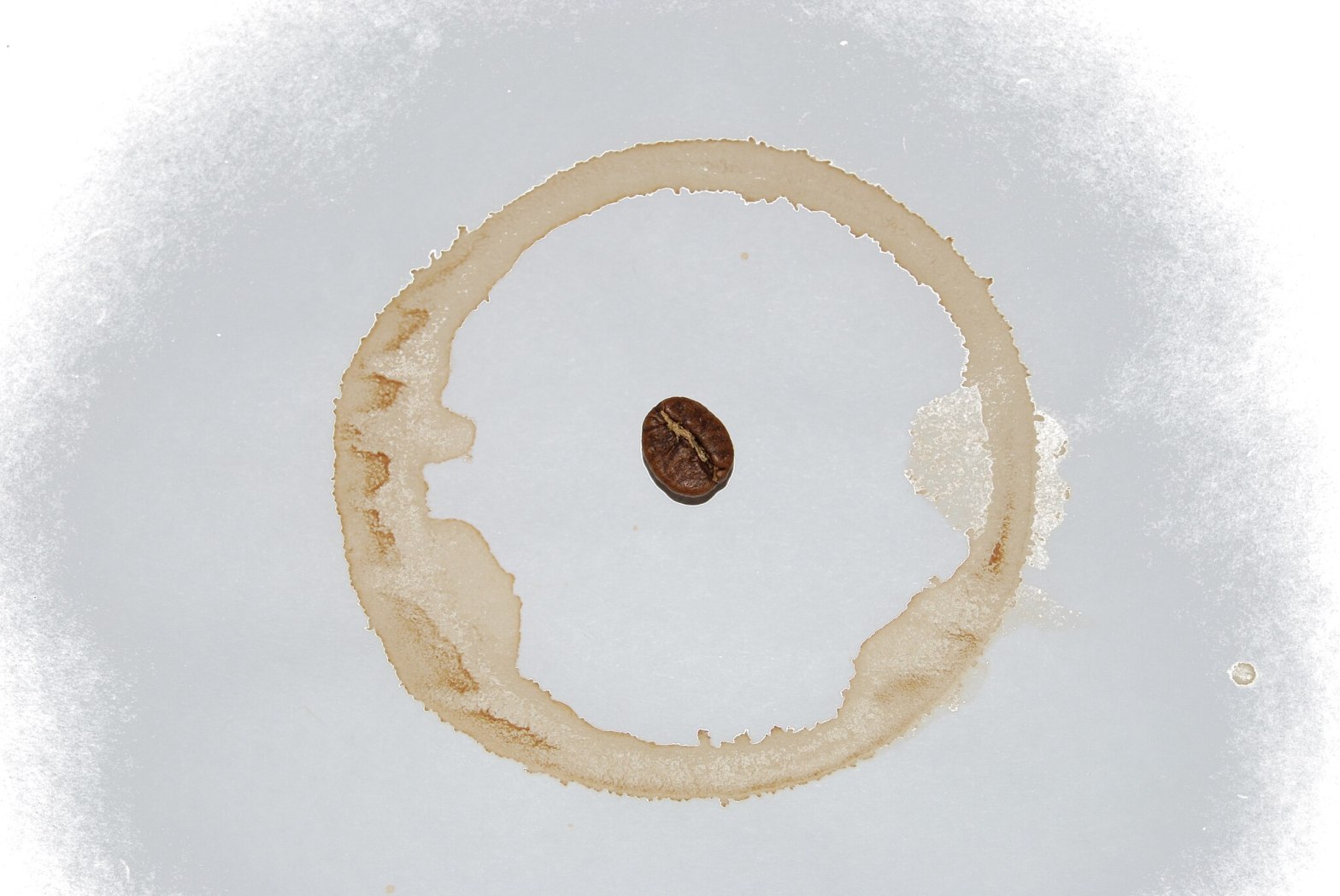
Most papers published in the fancy journals Nature or Science are not much different from papers in regular journals, but a few have real impact. One of these is a pioneering paper by Deegan and coworkers published in Nature in 1997 (pdf here). It has been cited almost 6000 times, which by coincidence is close to the total number of citations of everything I have published in a thirty-year scientific career. Bit of a shame I did not discover something that good in my PhD, I could have taken the other twenty-plus years off.
Teaching & assessing coding in the ChatGPT, Bard, etc era
I run second-year computing for physics undergraduates. The second semester part is taught as individual projects so is perhaps a little resistant to the problem of students just getting ChatGPT or Google’s Bard to do it. But the first semester includes very common basic problems like fitting to noisy data. The bad news here is that for standard simple tasks, ChatGPT and Bard will just give you answers, and so I can’t really have an assessment where students can just ask ChatGPT.
Airborne transmission of COVID and flu relies on the survival of DNA’s fragile cousin: RNA
Our genes and those of all organisms except some viruses, is encoded in long polymers of DNA. Even so, in organisms from bacteria to us, there are special enzymes ceaselessly working inside our cells to fix breaks that can occur in these long DNA polymers. These enzymes are keeping us alive. But not only are the genes of the viruses flu and SARS-CoV-2 made of fragile RNA not the tougher DNA, but as they are viruses they don’t have the metabolism to constantly fix any breaks in their RNA polymers. So how do these viruses with their fragile RNA genomes survive?
Where does the £50 cost of a graduate (e)textbook go?
At a recent meeting I bumped into the joint author of a very popular graduate textbook. It has gone through a couple of editions over 20 plus years and sold 10,000 plus copies in total. The current ebook version sells for about £50. Apparently the two authors get about a pound per copy each. This leaves £48 left. And total income over 20 plus years is maybe half a million, of which authors get around £20,000, leaving £480,000.
von Karman streets
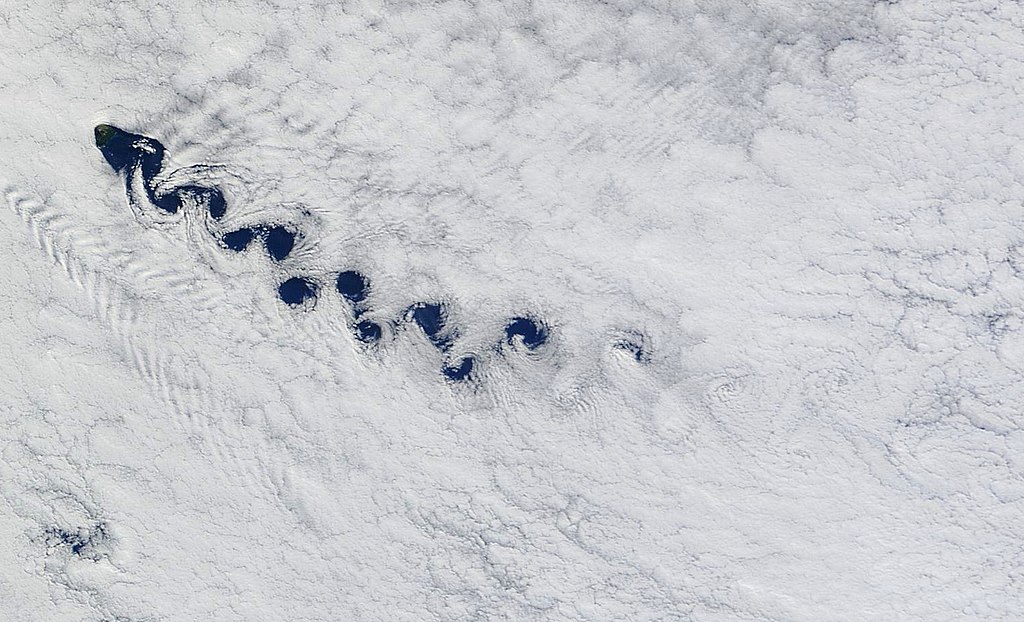
Theodore von Karman was a Hungarian-American fluid mechanics scientist/engineer active from early to the middle of the twentieth century. He was very smart and pioneered understanding the fluid flows needed for jet-powered flight. He was also the first to develop a theory for what are called von Karman streets. These can be rather beautiful, an example is shown above, in an image from a NASA satellite. At the top left of the image, the little green splodge is the island of Tristan da Cunha, an island in the South Atlantic. The von Karman street is the line of the swirls and holes in the clouds, that goes from top left to bottom right of the image. They have formed in the wake of the air of the atmosphere flowing around the peak of this island. The winds are blowing from top left to bottom right.
Is labelling foods “ultraprocessed” junk science?
There have been stories suggesting “ultraprocessed” foods are bad for you. This made me curious about what actually is a ultraprocessed food? How are ultraprocessed foods defined? So I did Googling* and, oddly, the British Heart Foundation has a detailed page on them that links to this document on the “NOVA classification”. The NOVA classification seems to be a standard*. I am no food scientist but this is a weird document.
Do A-level grades matter?
Depends on what you want to do, is the short answer.
The rest of this post is a short motivation followed by a longer but still partial answer*. On Saturday I read an article on that day’s coronation of Charles III, written by an A-level student already worrying about her exams. Students worrying about exams always makes me a bit sad. I like to see students working at learning physics – it was a pleasure to teach a computational physics class last week – but thinking about students hunched over books or laptops revising makes me a bit sad. This raises the question: Is this revision a necessary evil or an unnecessary burden on young people who could be doing more fun and more useful things with their young lives.
Which is harder to kill? Bad news wrapped in protein, or in soap?

Viruses have been described* as “bad news wrapped in protein” because many of them are just the genes of the virus – the bad news bit which takes over an infected cell – wrapped in a protein shell**. The wrapping is an elastic shell a few nanometres thick that is assembled from proteins. The image just below shows a reconstruction of such a protein shell:
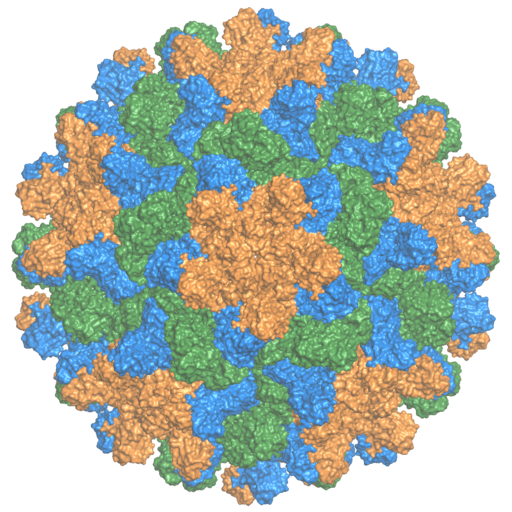
The colours are false, they just use different colours for different proteins. This protein shell protects the “bad news” inside. But not all viruses are like this. Some, such as SAR-CoV-2 shown at the top of this post, are “bad news wrapped in soap”. Instead of a shell made of an array of protein molecules, it is (mostly) made of soapy/fatty molecules called lipids (shown in grey).
Health risks of elevated carbon dioxide in the air we breathe
On Sunday the MailOnline published an alarmist article on what they say are the risks of wearing a face mask, due to elevated carbon dioxide (CO2). Masks are an obstacle to breathing and so although when you wear a mask you just breathe a little bit harder and so get all the oxygen you need, they do retain a bit of the carbon dioxide you breathe out. When you breathe in, you tend to breathe in more carbon dioxide then if you are not wearing a mask. This is a well-known problem and the FFP2 standard for masks specifies that the carbon dioxide measured should be no more than 1%, which is 10,000 ppm* (parts per million). If you look at an FFP2 standard certificate you see they measure the carbon dioxide (via a method I don’t quite follow but I assume people have worked out a good way). For that case they measured carbon dioxide at 0.6% or 6,000 ppm.
 Chance & Necessity
.jpg)