It is week four of the second of our two semesters of the teaching year. The exam results from last semester are out, and our final years can see the end of their course in sight. They have only one more set of university exams. Last week was our MPhys Research Year Symposium, where our MPhys students gave talks on what they did during a year doing a research project. As usual the talks I caught (I had to miss some) were excellent. Also last week, I was on a panel interviewing some of our final years for funding for a PhD. For all these reasons I have surrounded by evidence that many of our final years have learnt huge amounts over the last 3 or 4 years. They are transformed in terms of what they can do, and in their self-confidence, from the eighteen-year-olds that arrived a few years ago. As an academic who has taught them, this is really satisfying.
Scientists should listen to Donald Rumsfeld
Donald Rumsfeld is famous for his “unknown unknowns” quote. He has been much mocked for it. Normally, the last thing I would want to do is defend him, but I think this particular criticism of him is harsh. The full quote is:
“… there are known knowns; there are things we know we know. We also know there are known unknowns; that is to say we know there are some things we do not know. But there are also unknown unknowns — the ones we don’t know we don’t know. And if one looks throughout the history of our country and other free countries, it is the latter category that tend to be the difficult ones.”
It comes from a 2002 briefing when he was questioned about the lack of evidence for weapons of mass destruction in Iraq. Incidentally the Wikipedia page has fascinating discussion of this quote.
So hot its CRISPR
It looks a bit like science, but really isn’t
I am currently teaching a computational modelling course. This is assessed via a couple of reports. These student reports should cite references to back up their statements. For example if they are using a particular algorithm, they should cite a reputable work that describes that algorithm. The work should be a textbook, a peer-reviewed paper, or a good Wikipedia article – I think many Wikipedia articles are of a high standard, so one would be fine. Citing an article in The Sun newspaper would probably not be acceptable.
Youthful beauty queens do not prevent murder by scalding
2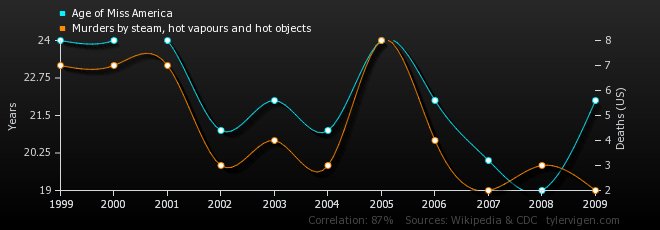 008 was a turbulent year in many ways. Our banking system almost crashed, and had to be rescued at taxpayers’ expense. It was also the year which marked the end of the previously impressive correlation between the age of Miss America and the rate of murder in the USA by steam and hot objects. Up until then, for every year with a youthful Miss America, the murder rate dropped, while when a slightly older woman was victorious, the murder rate increased. The correlation is quite impressive. I have seen a lot worse in plots in scientific papers.
Pubs to atomic weapons
In March I’ll be giving a physics careers talk at a Surrey school (Nonesuch School for Girls). I haven’t given a careers talk for ages, I used to do a fair few when I was admissions tutor but I stepped down from that job years ago. So I thought I would see what our graduates actually go on to do, to refresh my memory.
Cause and effect in the UK’s “top” universities
As a scientist I know that correlation does not imply causation. Just because two things, A and B, are correlated does not imply that A causes B or vice versa. For example, there is a correlation between the number of pirates on the world’s oceans, and global temperature, but this does not imply that pirates, or their absence, is causing global warming. But even if there is cause and effect going on, then you still have to work out if A causes B, or if B causes A.
The missing link
 Genes get a good press. The DNA double helix is a iconic, and we are all know that genes are how we inherit our mother’s blue eyes or our father’s curly hair. Proteins also have a good press. Food is sold as being “high in protein” — we know we need protein as part of a balanced diet. But the third key biological polymer, RNA, gets much less publicity. This is a shame, as our cells have a lots of it (more than DNA), and it is essential to all life on Earth.
Cancer’s a gamble but you can load the dice
This is an update on last week’s post on a paper on cancer by Tomasetti and Vogelstein. Fur has flown over this paper, in particular with some of the media coverage. There was an interesting, and angry, article in The Guardian, and remarkably an arm of the World Health Organisation (WHO) produced a press release on the paper. They were not impressed. And journalists reflected on their coverage of the article. It was all go.
Scientists have dug up a new antibiotic
As a society we have become very dependent on antibiotics since penicillin was introduced 70 years ago. Before then healthy adults would die of sceptic shock from massive infection. We don’t want to go back to those days, and so we need to develop new antibiotics at least as fast as the bacteria in hospitals are evolving resistance to our existing ones*.
 Chance & Necessity